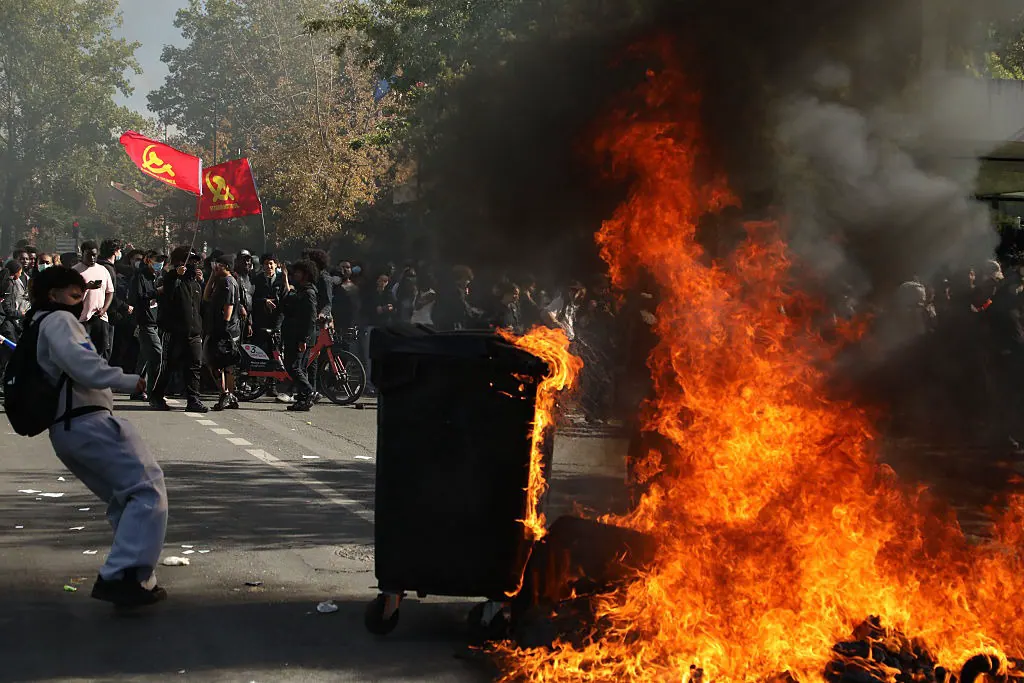
Tens of thousands of students and supporters have taken to the streets across France to protest deteriorating school facilities, overcrowded classrooms, and shortages of teachers and essential staff. The protests, which began in the Parisian suburbs, have spread to several cities, including Marseille, Strasbourg, Tours, and Lille. Demonstrations and blockades have been reported at over 1,200 high schools. Students are demanding improved learning conditions, citing inadequate resources and infrastructure.
In Aubervilliers, north of Paris, 17-year-old Maisa joined other students outside Lycée Le Corbusier to demand better learning conditions. Maisa, who hopes to become an English teacher, highlighted that students in disadvantaged neighborhoods bear the brunt of the education system’s problems. She recalled taking the high school French exam without a French teacher, emphasizing the significant impact teachers have on students. Maisa’s concerns were echoed by fellow students, who argue that current conditions are not conducive to studying.
Another student, 15-year-old Amelia, held a placard reading, “Our address should not decide our future.” She joined the demonstration to demand equal treatment for students regardless of where they live. Amelia accused the education authority of not investing enough in the suburbs, labeling the situation as classist and racist. Her sentiments reflect a broader frustration among students and parents, who feel that the education system is failing to provide adequate support.
At Lycée Le Corbusier, several subjects, including mathematics, humanities, English, and physical education, have reportedly been cancelled since the beginning of the academic year due to teacher shortages. Karima Kara Ali, an elected parents’ representative, confirmed the situation. The shortage of teachers is particularly acute in Seine-Saint-Denis, one of France’s poorer departments. The CGT education union reported that about two-thirds of high schools in the department participated in protests.
Students, parents, and teachers in four towns also raised concerns over inadequate sanitation and shortages of nurses and social workers. Louise Paternoster, a representative of the CGT education union in Seine-Saint-Denis, stated that the department is not receiving sufficient resources to meet the needs of its student population. A union survey found that two-thirds of schools in the department have vacant teaching positions. Paternoster blamed government cuts, which resulted in 3,256 teaching positions being eliminated nationwide in 2026.
In Pantin, northeast of Paris, teacher Dilan Roche joined her students during a protest outside their school, expressing support for their demands and protection amid police intervention. Roche highlighted concerns over overcrowded classes, lack of nurses, and social workers, which she believes are problematic for students with learning difficulties, many of whom live in precarity. Her participation underscores the solidarity between teachers and students in demanding better educational conditions.
The demonstrations have emerged as a political flashpoint for the French government, which announced unpopular spending reductions in its 2027 budget. The education budget is scheduled to rise by 1.7 percent to €65.53 billion, excluding teacher pensions. Education Minister Edouard Geffray stated that education remains a priority, arguing that the below-inflation increase is partly justified by existing commitments. The government faces pressure to address the concerns of students, parents, and teachers.
Key points
- Over 1,200 high schools in France have reported demonstrations and blockades.
- The protests are driven by concerns over overcrowded classrooms, teacher shortages, and poor school facilities.
- Government cuts have resulted in 3,256 teaching positions being eliminated nationwide in 2026.