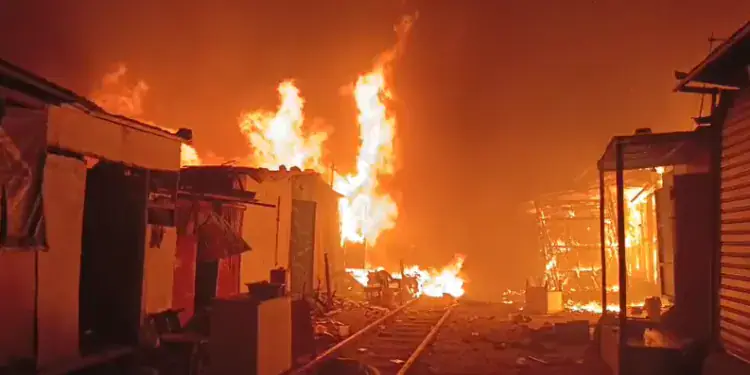
The Tema Region of Ghana has experienced a significant surge in fire outbreaks, with 22 incidents reported between November 9 and 18, according to the Ghana National Fire Service (GNFS). This represents a substantial increase from the usual one or two daily incidents, which have now risen to between three and four. The GNFS attributes this spike to the approaching Christmas season, a period often marked by an increase in fire outbreaks.
The rising concern over fire outbreaks in Ghana, particularly in the Tema region, has been highlighted by the GNFS's Public Relations Officer for the region, Divisional Officer II Ebenezer Yenzu. He stressed the need for intensified public education and increased vigilance to mitigate the risk of fires, which have become a major threat to Ghanaian businesses, especially market traders. The financial losses due to fires are substantial, with millions of cedis and properties lost during these incidents.
A national study by the National Insurance Commission (NIC) has identified fire as the leading risk threatening informal-sector businesses in Ghana. According to the NIC-YEA Insurance Awareness and Risk Perception Report, fire was cited by 41% of respondents, equivalent to 10,850 people, making it the most frequently reported business risk. Theft and robbery followed at 36%, while illness accounted for 34%. These findings suggest that insurance companies have an opportunity to attract more small businesses in the informal sector by offering affordable and suitable insurance products.
The NIC-YEA Insurance Awareness and Risk Perception Report was based on data collected from 26,493 people across 10 regions of Ghana by 218 graduates of the Youth Employment Agency (YEA) over a period of three months. The analysis of the data indicated that market traders had a median amount of GH¢25 per week, while drivers recorded a higher median of GH¢30 per week. Artisans were willing to pay a median of GH¢20 a week for insurance, the same as the national figure.
The report found that half of the respondents were willing to pay between GH¢10 and GH¢50 weekly, with GH¢20 representing the national median. Based on the findings, the National Insurance Commission (NIC) proposed three pricing levels for insurance products targeting informal businesses. Basic coverage would cost between GH¢10 and GH¢15 a week, standard packages between GH¢20 and GH¢30, while comprehensive cover would range from GH¢40 to GH¢60.
The amount respondents were willing to pay for insurance also varied across regions. Those in Ashanti, Greater Accra, and Bono recorded a median of GH¢30 per week, compared with GH¢10 among respondents in the Northern and Volta regions. The findings point to the need for insurance products that match the financial circumstances of informal businesses while protecting against the risks they face.
To make insurance easier to access, the report recommends allowing customers to pay premiums weekly through mobile money, simplifying claims processes, and issuing policies digitally. However, the amounts respondents said they were willing to pay may not necessarily translate into actual purchases, highlighting the need for insurers to offer affordable premiums, explain policy terms clearly, and settle claims reliably to encourage more informal businesses to take up and maintain insurance coverage.
Key points
- Fire outbreaks have increased in the Tema region, with 22 incidents reported in 10 days.
- The National Insurance Commission proposes three pricing levels for insurance products targeting informal businesses.
- Insurers need to offer affordable premiums and clear policy terms to encourage informal businesses to take up insurance coverage.