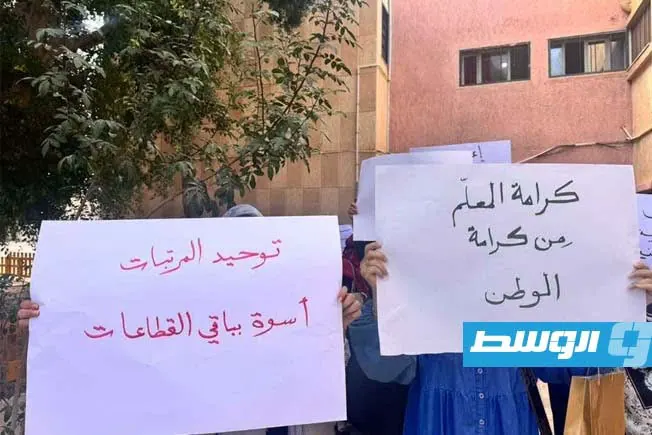
A nationwide strike by Libyan teachers has brought together educators from across the country, united in their demands for better pay and working conditions. The strike, which began in mid-September, has affected 1.6 million students in primary and secondary schools. The teachers are seeking a unified salary scale, payment of delayed allowances, and provision of health insurance. The strike has disrupted the start of the academic year, which was initially set for September 6 but was postponed to September 13 due to maintenance work in some schools.
The strike has gained support from the Libyan Teachers' Union, with teachers from various cities, including Tripoli, Benghazi, Zawara, Misrata, and Az-Zintan, participating in protests. According to Fatima Ali, a teacher from Tripoli, Libyan teachers are struggling with high living costs, and their participation in the strike aims to demand rights that have not been met since 2018. The strike has been marked by demonstrations, including a gathering in front of the government headquarters in Tripoli.
The teachers' union is demanding a unified salary scale for all state employees, which they believe will bring greater social justice. They also want the payment of delayed allowances and provision of health insurance. According to Ashraf Abu Rawi, the spokesperson for the Libyan Teachers' Union, teachers in the public sector earn between 1,000 and 2,500 Libyan dinars per month. The union is calling for concrete actions to address their demands, rather than just promises.
The strike has highlighted the challenges faced by teachers in Libya, including differences in pay between sectors. The Libyan Ministry of Education employs around 217,000 teachers and 266,000 administrative staff, with an additional 130,000 surplus employees. The ministry is exploring ways to integrate teachers and administrative staff into a health insurance program but has not yet addressed the issue of salary reviews.
The Libyan government is working to find a solution to the crisis, with the Ministry of Education discussing ways to make up for the lost academic time. The ministry is considering adjusting the academic calendar, including canceling or postponing some holidays, to ensure students do not fall behind. However, the strike continues, with teachers refusing to back down until their demands are met.
The strike has united teachers across the country, with participation reported to be 100% nationwide. The union is insisting on concrete actions to address their demands, rather than just promises. The strike has also drawn attention to the challenges faced by the education sector in Libya, including the need for better pay and working conditions for teachers.
The situation remains uncertain, with no clear resolution in sight. The Libyan government faces pressure to address the teachers' demands and find a solution to the crisis. The strike has disrupted the academic year, and it remains to be seen how the situation will be resolved.
Key points
- - The strike has united teachers across Libya, with 100% participation nationwide. - Teachers are demanding a unified salary scale, payment of delayed allowances, and provision of health insurance. - The strike has affected 1.6 million students in primary and secondary schools.