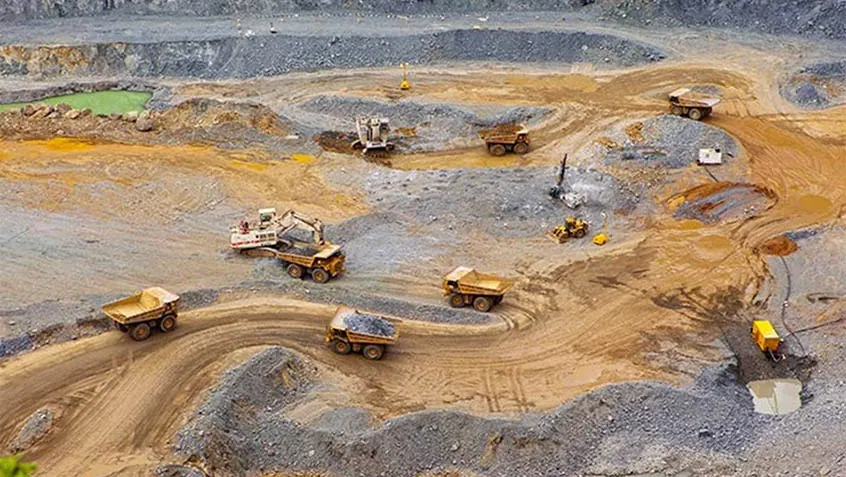
The Tanzanian government has called on local companies to combine their capital, technology, and expertise to take advantage of 14 major mining projects in the development pipeline. This move is expected to expand the industry's procurement market, which is currently worth around 5.1 trillion Tanzanian shillings (tri/-) annually. Minister for Minerals Anthony Mavunde stated that local businesses need to scale up early to meet the demands of the new mining projects.
The 14 major projects are expected to create demand for various services, including engineering, equipment, explosives, technology, maintenance, and professional services. Mr. Mavunde emphasized that domestic companies should move beyond routine supply contracts and build the necessary financial and technical capacity to compete for larger and more specialized assignments. This will enable them to benefit from the mining industry's procurement market, which the government aims to keep within Tanzania.
The government targets at least 90 percent of the mining industry's expenditure to remain in Tanzania, allowing a larger share of mining activity to benefit local businesses, employment, technology, and industrial production. The market could expand further as the 14 major projects advance, while holders of another 28 graphite mining licenses are being encouraged to move towards production. Local firms are urged to overcome fragmented competition by combining finance, equipment, technology, and professional expertise.
Mr. Mavunde directed the Mining Commission to audit companies operating through joint ventures with Tanzanian partners, focusing on whether local shareholding is reflected in the actual business, transactions, and benefits generated from contracts. The Mining Act requires mineral-right holders to give preference to goods produced or available in Tanzania and services provided by Tanzanians or local companies. This move aims to ensure local-content partnerships develop genuine businesses and technical capability.
Mining Commission Chairperson Dr. Janet Reuben Lekashingo stated that partnerships with foreign companies have helped bring capital, technology, skills, and experience into Tanzania. However, the goal is to move Tanzanian firms from participation into ownership, from low-value assignments into higher-value activities, and from dependence towards competitiveness. Local companies are encouraged to take a larger role in drilling, engineering, explosives, mining technology, equipment maintenance, and manufacturing inputs used by mines.
Employment in the mining sector has increased, with Tanzanians now holding about 96 percent of more than 19,000 formal mining jobs, including an increasing number of senior technical and management positions. The government is also investing more in geological exploration, with President Dr. Samia Suluhu Hassan approving the allocation of 10 percent of mining-sector collections to mineral exploration.
The mining sector collected 411 billion Tanzanian shillings in the first quarter of the 2026/27 financial year, equivalent to 117 percent of the 350 billion Tanzanian shilling target. Mining contributes about 10.3 percent to Tanzania's gross domestic product. The government's efforts aim to establish businesses capable of manufacturing, engineering, and servicing more mining products in Tanzania and eventually competing for business elsewhere in the region.
Key points
- The Tanzanian government aims to keep at least 90 percent of the mining industry's expenditure within the country.
- Local companies are urged to combine resources to tap into the new wave of mining projects.
- The mining sector has collected 411 billion Tanzanian shillings in the first quarter of the 2026/27 financial year.