Australian mining company EcoGraf Limited has announced plans to potentially increase production capacity at its Epanko Graphite Project in Tanzania by 20%. The proposed increase to 87,600 tonnes per annum is based on a Value Engineering Review, which found that the higher throughput could be achieved with minimal design changes to the project's layout. This development comes as the company advances its plans for the project, which is expected to play a significant role in the global graphite market.
The Value Engineering Review, undertaken by METC-PaulSam JV, revealed that many of Epanko's existing plant designs can accommodate higher throughput with limited modifications. The review identified key improvements, including selective additions to flotation capacity, minor classification and screening upgrades, and potential optimisation of concentrate filtration and drying circuits. These changes are expected to be implemented at a relatively low cost, with approximately 44% of major equipment requiring modification.
According to the review, the potential 20% increase in throughput would require an additional USD 12.0 million in initial capital, primarily for the processing plant and tailings storage facility. This cost falls within the existing contingency allowance outlined in the Updated Bankable Feasibility Study (Updated BFS). The increase in production capacity would also lead to a reduction in operating costs, with C1 operating costs estimated at approximately USD 515.9 per tonne of concentrate sold over the life of mine.
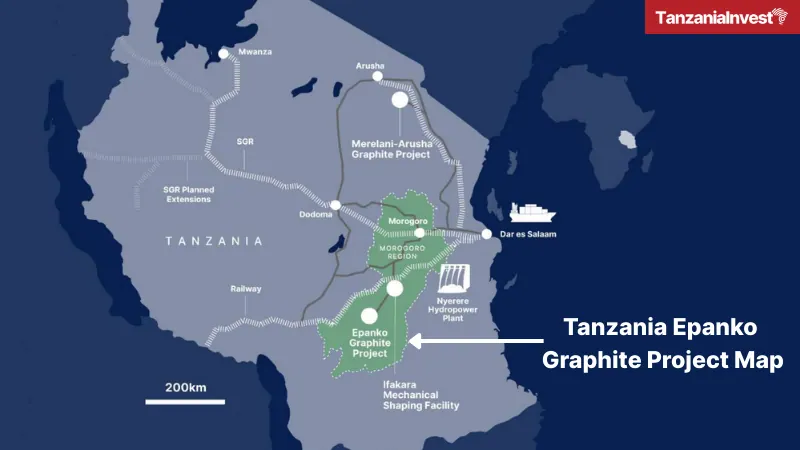
The Epanko Graphite Project, located in the Mahenge Graphite Province approximately 370 kilometres from Dar es Salaam, is being developed and operated by Duma TanzGraphite, in which EcoGraf holds an 84% interest. The Government of Tanzania holds a 16% free-carried interest in the project. The project has been granted a 25-year Special Mining Licence, expanding the licensed mining area from 9.6 to 18.9 square kilometres.
EcoGraf has also reported positive progress on strategic equity and offtake discussions, supported by industry interest in its HFfree purification technology and downstream battery materials strategy. The company has an agreement with Mitsubishi Chemical Corporation for up to 10,000 tonnes per annum of purified spherical graphite. Additionally, EcoGraf holds existing sales agreements with Germany's ThyssenKrupp AG, Japan's Sojitz Corporation, and a major European trading group.
The Epanko Graphite Project is based on an existing Ore Reserve of 16.7 million tonnes at 8.2% total graphitic carbon. The potential 20% increase in throughput would shorten the project's life of mine to 20 years, from the 22 years disclosed in the Updated BFS. The project is expected to support the initial development of a single 25,000 tonnes per annum HFfree Battery Anode Material facility, part of EcoGraf's expanding development initiatives in Europe, Asia, and the United States.
EcoGraf has received a European Investment Bank (EIB) Technical Assistance grant of up to EUR 2 million to support engineering studies on the expansion case. The studies will be advanced to Bankable Feasibility Study level, with a focus on independent technical, environmental, and social assessments. The company is yet to quantify the potential impact on the project's net present value and internal rate of return, which will be assessed alongside the EIB-supported technical assistance work.
Key points
- EcoGraf Limited considers increasing Epanko Graphite Project output by 20% to 87,600 tonnes per annum
- The potential increase in production capacity would require an additional USD 12.0 million in initial capital
- The project has been granted a 25-year Special Mining Licence, expanding the licensed mining area from 9.6 to 18.9 square kilometres