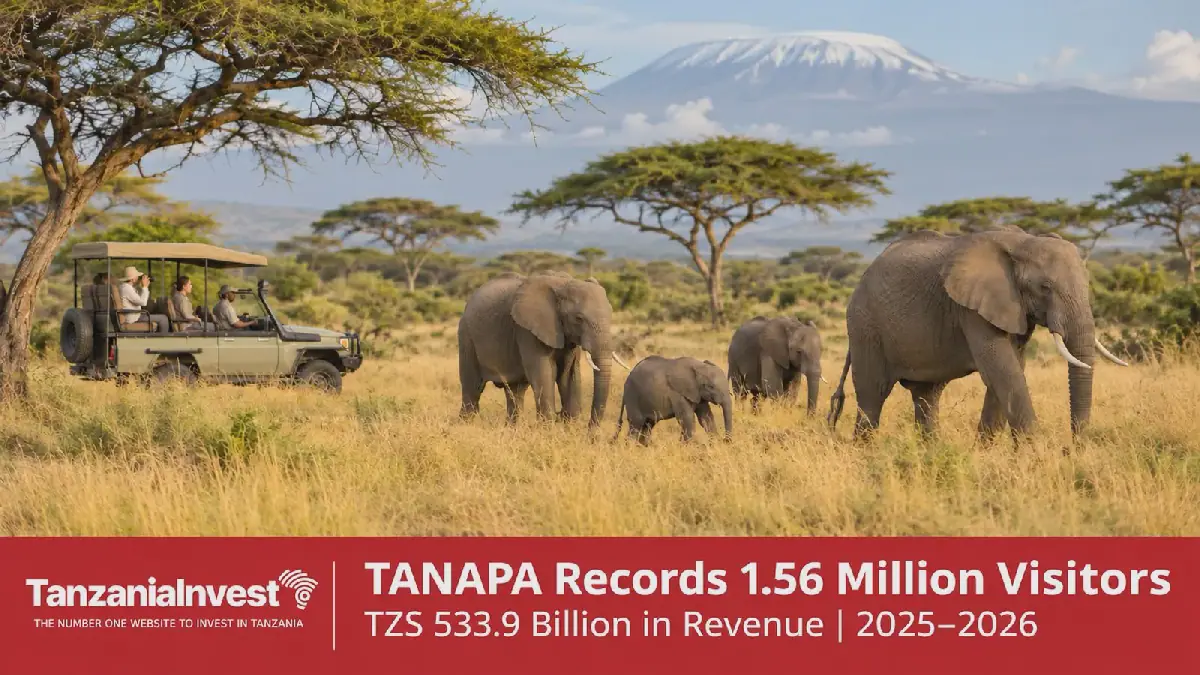
The Tanzania National Parks Authority (TANAPA) has reported a significant increase in visitors and revenue for the 2025-2026 financial year. According to TANAPA's results, 1,559,441 visitors were recorded across its 21 national parks, generating TZS 533.9 billion in revenue. This represents an average annual growth of approximately 24% in visitors and 40% in revenue compared to the 2021-2022 financial year. The growth is attributed to various factors, including the Royal Tour documentary featuring Tanzania's President Samia Suluhu Hassan.
TANAPA has diversified its tourism products to attract different visitor segments. The Authority offers hot-air balloon safaris in Serengeti and Tarangire national parks, exclusive black rhino viewing in Serengeti and Mkomazi national parks, and horseback safaris in Arusha National Park. Additionally, TANAPA provides catch-and-release sport fishing in Nyerere, Ruaha, and Katavi national parks, as well as hot springs tourism in Ruaha National Park. The Authority is also developing sports tourism through an 18-hole golf course in the Fort Ikoma area of Serengeti National Park.
TANAPA has made progress in protecting endangered wildlife over the past five years. The number of black rhinos has increased from 128 in 2021 to 170 in 2026. Chimpanzee numbers have also risen from 196 in 2021 to 288 in 2026 across Gombe, Mahale Mountains, and Rubondo Island national parks. The Authority has established a captive-breeding and rewilding programme for African wild dogs in Mkomazi National Park to rebuild populations threatened by human-wildlife conflict.
In a separate operation, TANAPA relocated approximately 400 elephants from Kitengule Ranch in Kagera Region to Burigi-Chato National Park using helicopters, drones, and satellite tracking. The relocation aimed to reduce damage to sugarcane and banana farms. TANAPA has also intensified anti-poaching efforts, arresting 35,559 suspects, confiscating 105 weapons, and recovering 6,860 illegally grazed livestock.
TANAPA has expanded the use of technology to improve wildlife monitoring, park security, and tourism management. The Authority has deployed 40 drones for aerial surveillance, boundary monitoring, wildlife tracking, and rapid ranger deployment. TANAPA plans to increase its drone fleet to 100 over the next five to ten years. Additionally, the Authority has invested in GPS satellite collars for tracking key herd leaders, sniffer dogs, patrol aircraft, and modern command and control centres.
Beyond wildlife protection, TANAPA has undertaken ecosystem restoration programmes to improve biodiversity and maintain natural habitats. The Authority has removed invasive plant species across 440.22 hectares in 15 parks and cleared 1,546 hectares of dense bush in Lake Manyara National Park to restore grazing areas. TANAPA has also restored the Katavi-Mahale wildlife corridor with support from the German government.
To accommodate growing visitor numbers, TANAPA has expanded accommodation, park access infrastructure, and investment opportunities for private tourism operators. The Authority has allocated 130 investment sites for new lodges and camps, with a focus on the Southern, Eastern, and Western tourism circuits. Bed capacity across hostels, rest houses, permanent camps, and lodges has increased from 575 in 2021 to 1,294 in 2026.
Key points
- TANAPA reports 1,559,441 visitors and TZS 533.9 billion in revenue for the 2025-2026 financial year.
- The Authority has diversified its tourism products to attract different visitor segments.
- TANAPA has made progress in protecting endangered wildlife, including the recovery of black rhinos and chimpanzees.