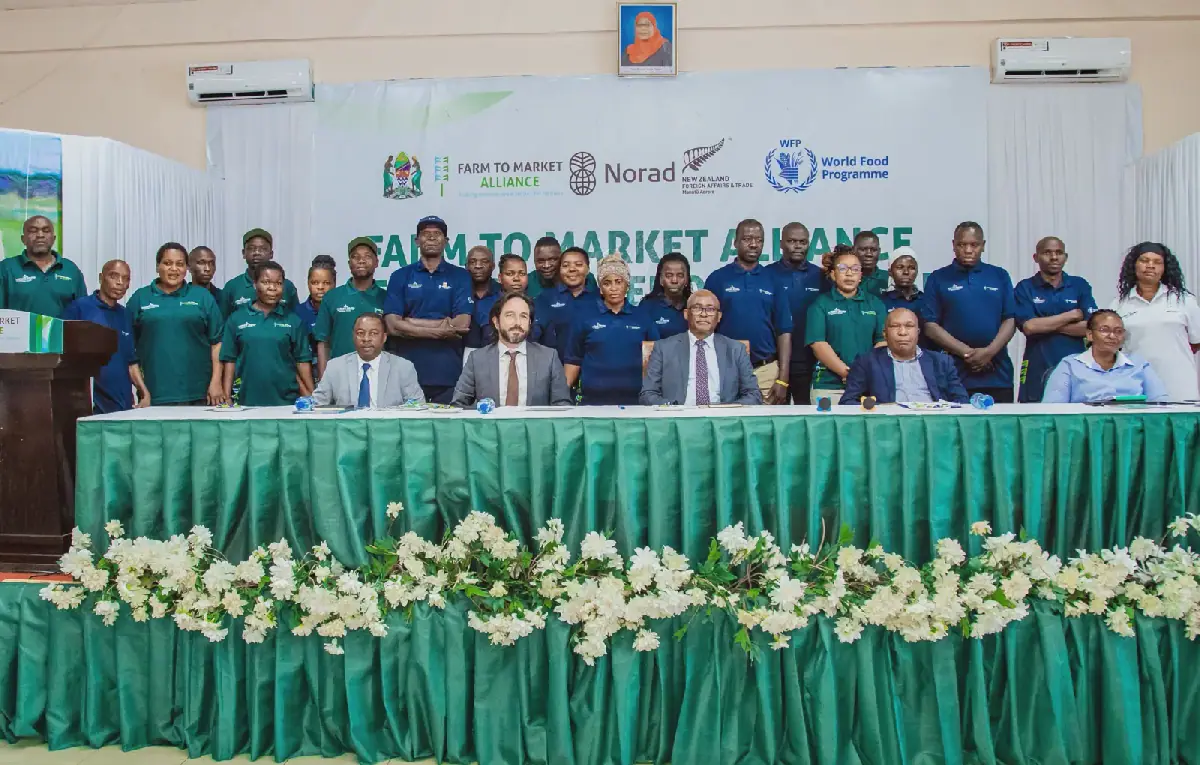
The Tanzanian government is promoting the expansion of successful Farmer Service Centres (FSCs) to strengthen rural agribusiness and support smallholder farmers. Deputy Permanent Secretary in the Ministry of Agriculture, Prof Peter Msofe, urged the centres to demonstrate their sustainability by mentoring emerging enterprises. The FSC model has connected over 250,000 smallholder farmers to agricultural services and markets through 924 centres across 18 districts.
Prof Msofe spoke at the conclusion of the 10-year Farm to Market Alliance (FtMA) programme, which established the FSCs through partnerships between the government, private sector, and development organisations. He stressed that the programme's closure should not mark the end of the FSC model, which has shown promising results. The centres provide essential services, including quality seeds, fertilisers, mechanisation, extension advice, financial services, and market information.
A total of 108 centres have met the required standards, and Prof Msofe encouraged their operators to mentor others and help expand the network. He suggested that if each of the successful centres establishes another one, their number could increase to 216. The FSCs serve as rural agribusiness hubs, aggregating produce from smallholder farmers and connecting it to larger markets, improving quality, reducing transportation costs, and strengthening farmers' bargaining power.
The FSC model supports the government's agricultural transformation agenda, particularly the Agriculture Master Plan 2050, by improving productivity, profitability, and competitiveness. Prof Msofe urged stakeholders to strengthen access to quality inputs, climate-resilient technologies, storage, processing, markets, and affordable finance. The programme, implemented by the United Nations World Food Programme (WFP), worked with partners Farm Africa and Nafaka Kilimo.
The FtMA programme achieved significant results, including the aggregation of over 254,000 tonnes of produce valued at over $52 million. Farmers and centres accessed inputs and services worth over $15 million, and the network includes 408 youth-led centres, reaching approximately 95,000 women and 70,000 young farmers. WFP Country Director Ronald Tran Ba Huy said the centres had evolved into commercially viable local agribusinesses.
Stakeholders, including financial institutions, private sector, development partners, and research organisations, must commit to sustaining the gains. The WFP will integrate the FSC approach into its wider resilience, livelihoods, and market assistance activities. FtMA Deputy Managing Director Anastasia Mbatia said the model had proved adaptable to different agricultural settings.
Individual businesses have also benefited from the programme, as seen in the experience of Dorah Mkelele, a 50-year-old entrepreneur from Mufindi District. She attributed her success to training, business forums, and market linkages provided by FtMA, which helped her grow her agro-input enterprise and connect with suppliers. The programme reached over 700,000 farmers through over 3,000 centres in Tanzania, Kenya, and Rwanda.
Key points
- The Tanzanian government aims to expand the Farmer Service Centre model to improve agricultural productivity and profitability.
- The centres provide essential services, including quality seeds, fertilisers, and market information, to smallholder farmers.
- The programme has reached over 700,000 farmers through over 3,000 centres in Tanzania, Kenya, and Rwanda.
Reporting sources
- Govt pushes expansion of farmer service centres · Daily News