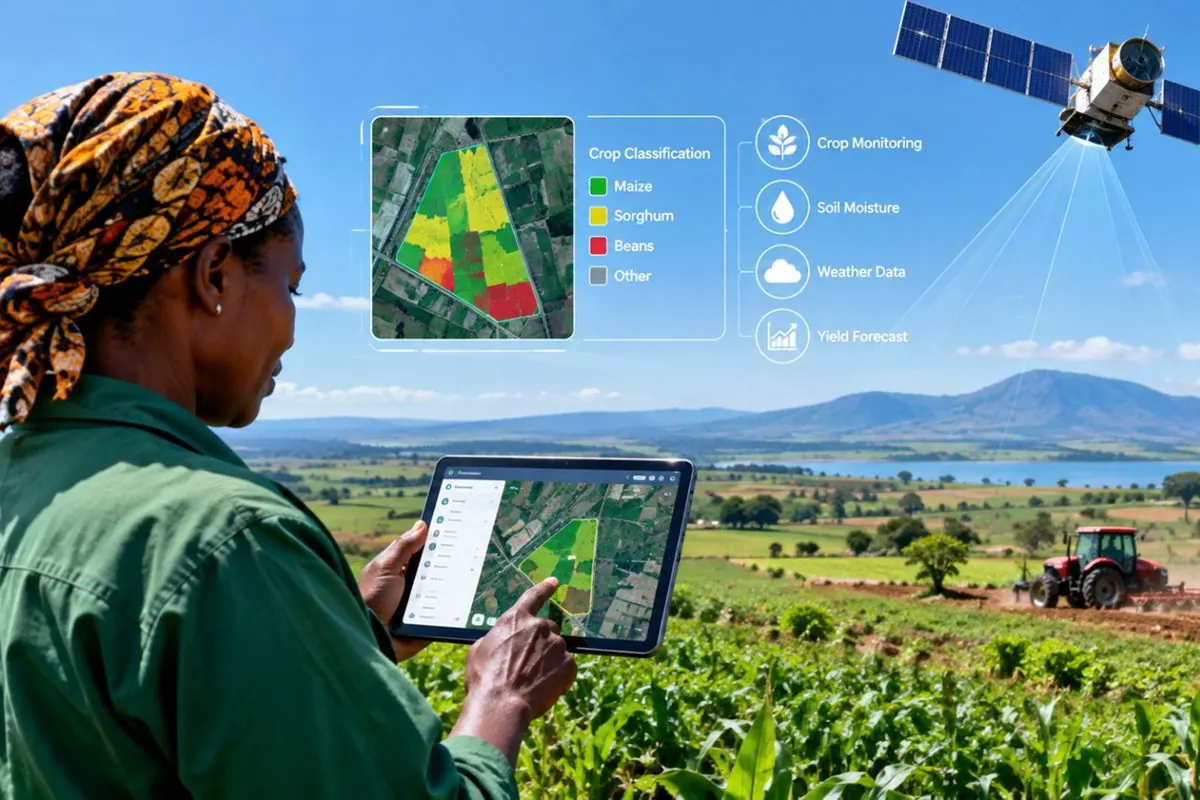
Tanzania is looking to modernize its agriculture sector by leveraging space technology, with a delegation of policymakers and innovators recently visiting Finland to study its use of satellite imagery, artificial intelligence, and mobile technology. The Finnish system allows authorities to remotely monitor millions of agricultural parcels, identify discrepancies between farmers' declarations and actual crops, and request geotagged photographs before approving payments. This approach has the potential to improve crop monitoring, weather and climate information, agricultural planning, and service delivery to farmers in Tanzania.
The Tanzanian delegation's visit was part of the European Union-funded Digital4Tanzania (D4T) Twinning project, which aims to expose policymakers and stakeholders to digital systems that can inform Tanzania's digital transformation agenda. The project has brought together Finnish and Tanzanian experts to share knowledge and best practices in using space technology for agricultural development. Finland's experience in using satellite-based agricultural monitoring systems offers valuable lessons for Tanzania as it seeks to expand its own use of space technology.
Finland's satellite-based agricultural monitoring system combines Sentinel satellite imagery, radar data, weather information, land-parcel records, and artificial intelligence to monitor agricultural activity. The system can identify crops and farming activities and compare them with farmers' declarations. According to Finnish expert Ake Moller, the system uses optical and radar data to analyze agricultural activity and detect discrepancies. This approach has enabled Finland to process hundreds of thousands of images, reducing the need for manual inspections.
Tanzania's agriculture sector is a significant contributor to the country's economy, accounting for 24.6 percent of GDP and 64.6 percent of employment in 2025. However, the sector's scale makes it challenging to collect timely and accurate information through conventional methods. The use of space technology has the potential to address these challenges and improve the efficiency of agricultural monitoring and service delivery. The Food and Agriculture Organisation notes that geospatial technologies can make agricultural monitoring more cost-effective.
Tanzania is already investing in satellite technology and seeking to modernize its agriculture sector. In May 2025, the International Fund for Agricultural Development and China launched the $2.268 million SAT-CARE project to use satellite-based digital solutions for climate-resilient agriculture. The project aims to directly benefit 5,000 smallholder farmers and indirectly reach up to one million farmers. The country's National Food Security Bulletin is already using satellite-derived vegetation data to inform food-security assessments.
The Tanzanian government is strengthening the regulatory foundation for satellite technology, with the Tanzania Communications Regulatory Authority (TCRA) issuing guidelines for satellite filings in 2024 and satellite landing rights in 2025. The government is also developing a national space programme and working towards its own satellite capability. However, the challenge now is to connect these investments to practical services that can benefit farmers and the broader agricultural sector.
The EU's Digital4Tanzania e-Governance Support Programme, running from 2022 to 2026 with a €35 million budget, is designed to strengthen digital government services, connectivity, and Tanzania's innovation ecosystem. The programme's goal is to build practical capacity that fits the Tanzanian context, rather than simply transferring a Finnish model wholesale. By leveraging space technology and digital solutions, Tanzania aims to improve the efficiency and effectiveness of its agriculture sector.
Key points
- Tanzania is studying Finland's use of satellite imagery and AI to monitor farmers' fields and process subsidy payments.
- The country is investing in satellite technology to modernize its agriculture sector and improve crop monitoring and service delivery.
- The EU's Digital4Tanzania programme is supporting Tanzania's digital transformation agenda and building practical capacity in the use of space technology for agricultural development.