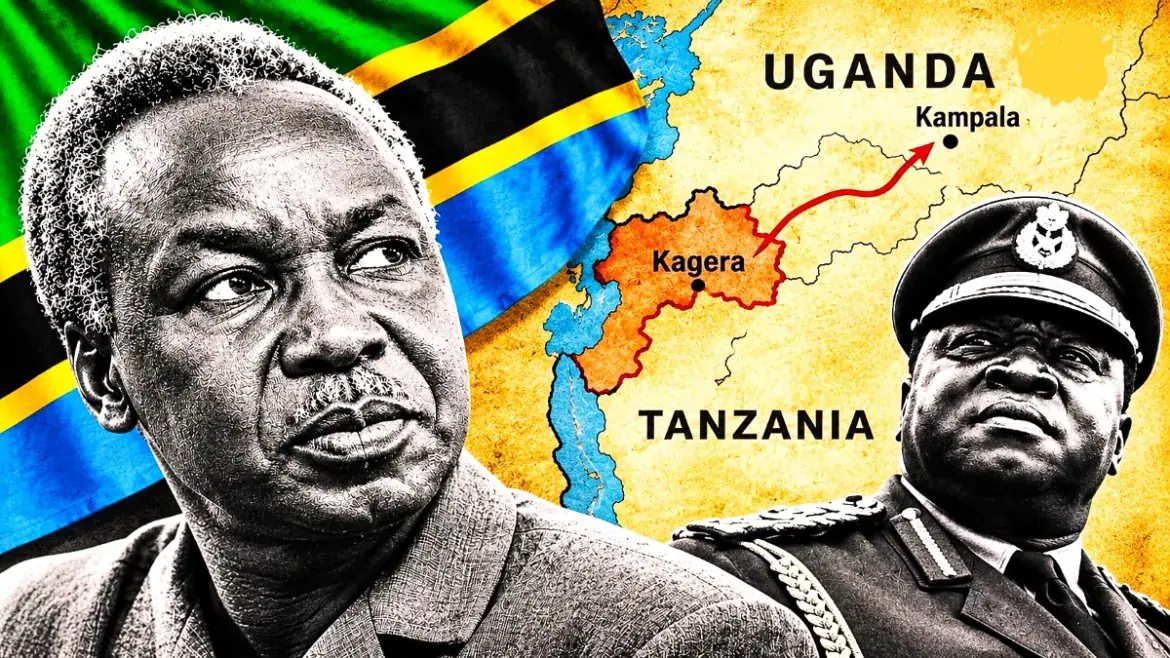
On November 1, 1978, Radio Uganda announced that Idi Amin's forces had occupied part of Tanzania, sparking a conflict that would have far-reaching consequences. The invasion was marked by the killing of civilians, looting of homes and businesses, and destruction of property. President Julius Nyerere faced a difficult decision in responding to the aggression, with Tanzania already experiencing serious economic pressures. The Organization of African Unity had not condemned the invasion, and African leaders called for a peaceful settlement.
President Nyerere rejected mediation efforts by Mobutu Sese Seko of Zaire and President Jaafar Nimeiri of Sudan, demanding instead that Uganda's actions be condemned and restrictions be placed on supplies to the Kampala government. Tanzania's military response ultimately led to the reclamation of the Kagera Salient, but Nyerere chose not to stop at the border. By January 1979, Tanzanian forces were operating inside Uganda, with the goal of protecting Tanzania's territorial integrity and preventing future invasions.
The war continued, with a major battle at Lukaya in March and the eventual fall of Kampala on April 11, 1979, marking the end of Idd Amin's rule. Despite support from Libyan leader Muammar Gaddafi, who had sent troops to assist Kampala, Tanzanian forces emerged victorious. However, the cost to Tanzania was enormous, with an estimated daily expenditure of US$1 million and a total war cost of over US$500 million.
The human cost of the war was also significant, with 373 Tanzanian military deaths recorded and a separate count of 435 dead victims buried at Kaboya, including several Ugandans. Most African leaders had quietly welcomed Amin's fall, but Tanzania carried a substantial part of the cost. The country's economy began to decline after the war and never recovered, with observers questioning whether taking the war into Uganda was worth the price Tanzania paid.
The war had significant regional implications, with the Organization of African Unity ultimately failing to condemn Uganda's actions. Tanzania's decision to intervene in Uganda was motivated by a desire to protect its territorial integrity and prevent future invasions. The campaign was marked by significant military victories, including the battle at Lukaya, which helped to weaken Amin's forces.
In the aftermath of the war, Tanzania appealed to nine donor governments for US$375 million to help cover the costs of the conflict. However, by July 1979, the appeal had received no positive response. The economic burden of the war had a lasting impact on Tanzania, contributing to a decline in the country's economy that was never fully reversed.
The legacy of the war continues to be debated, with questions about whether Tanzania's intervention was necessary and whether the costs outweighed the benefits. While the ousting of Idd Amin was widely welcomed, the significant economic and human costs of the war had a lasting impact on Tanzania. The country's experience serves as a reminder of the complexities and challenges of regional conflict and the importance of careful decision-making in responding to aggression.
Key points
- Tanzania's economy suffered significantly after the war with Uganda in 1979.
- The war resulted in the deaths of hundreds of Tanzanian soldiers and civilians.
- The conflict had significant regional implications, including the eventual fall of Idd Amin's regime.
Reporting sources
- African Leaders lauded the fall of Idd Amin but Tanzania paid the price · The Tanzania Times – News from Tanzania, Africa, World, Breaking News, Weather, Environment and Climate Change