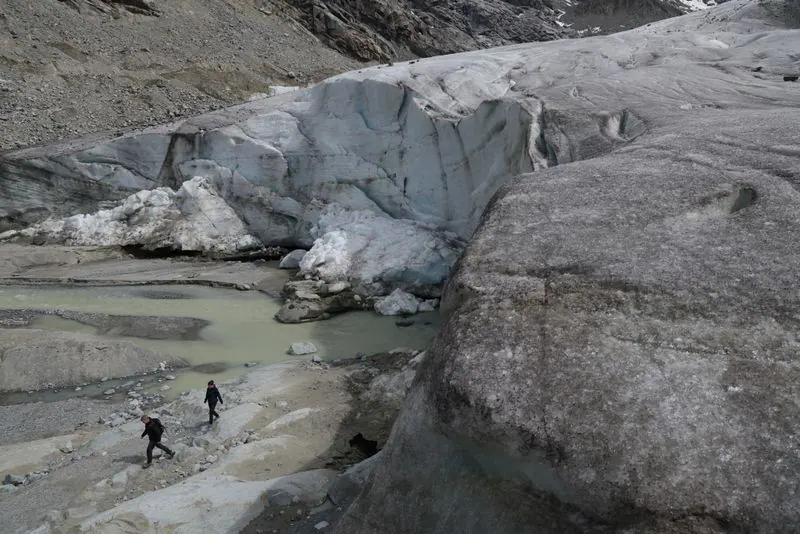
Swiss glaciers have experienced a significant loss of ice in 2026, with a report by the Swiss Glacier Monitoring Network and the Swiss Commission for Cryosphere Observation of the Swiss Academy of Sciences revealing that they have lost more than 5% of their ice. This loss is attributed to a combination of a winter with too little snow and record temperatures in the summer, leading to what has been described as "enormous" melting.
The report highlights that over the past five years, Swiss glaciers have shed almost a fifth of their ice, threatening future water supplies and raising questions about the long-term survival of Europe's ice fields. The accelerating pace of glacier retreat is a cause for concern, with extreme melt years becoming routine. The Morteratsch glacier, for example, has lost at least 3.1 kilometers in length since 1900, with approximately 1.4km disappearing since 1990.
According to the report, Swiss glaciers lost an average of 25% of their volume between 2010-2024. The largest glacier in Switzerland, Aletsch Glacier, suffered its biggest-ever melt this year, while Glacier de Tsanfleuron lost more than four meters of average thickness. These findings are a stark reminder of the impact of climate change on glaciers.
The director of the Swiss Glacier Monitoring Network, Matthias Huss, has described the situation as "really worrying." He notes that extreme years of melting are becoming almost routine, and the rate of ice loss has not yet quite reached the record highs of 2022. However, the sheer scale of ice loss is still alarming, with an estimated 2.2 trillion liters of water lost between July and September alone.
The loss of ice has significant implications for water supplies, as glacier melt contributes to easing summer water shortages. However, as ice-covered areas shrink and glaciers become smaller, this benefit is decreasing. Huss notes that it's not just the data that is concerning, but also the visual impact of the melting glaciers, with rocks exposed where there was once snow.
The report's findings are a stark reminder of the impact of climate change on glaciers. The loss of ice is not just an environmental concern, but also has significant implications for water supplies and ecosystems. As the climate continues to warm, it is likely that glaciers will continue to shrink, with potentially devastating consequences.
The situation in Switzerland is a microcosm of a global problem, with glaciers around the world experiencing significant losses due to climate change. The report's authors are calling for urgent action to address the root causes of climate change and mitigate its impacts on glaciers and ecosystems.
Key points
- Swiss glaciers have lost over 5% of their ice in 2026 due to a record-breaking European heatwave.
- The loss of ice has significant implications for water supplies, as glacier melt contributes to easing summer water shortages.
- The report's findings are a stark reminder of the impact of climate change on glaciers, with extreme melt years becoming routine.