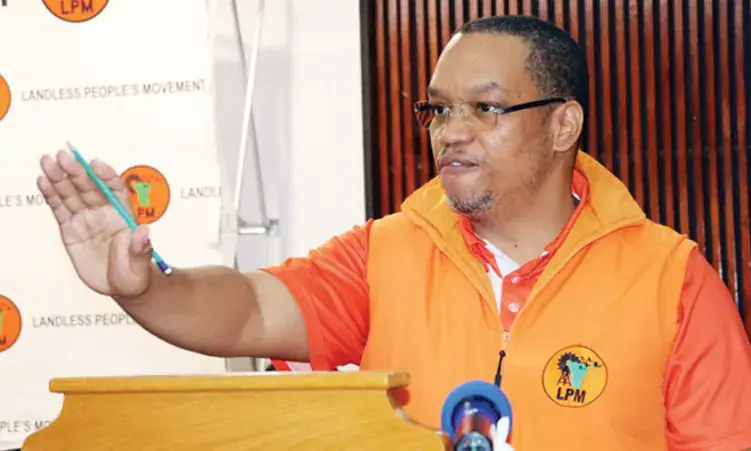
Landless People’s Movement (LPM) leader Bernadus Swartbooi stated that the growing number of people borrowing from microlenders shows how difficult life has become for ordinary Namibians. He made these remarks in the National Assembly during his contribution to the mid-term budget review debate on Thursday. Swartbooi highlighted that microlenders recorded a 27% increase in their loan portfolios, reaching N$9.3 billion in the second quarter of 2026.
According to Swartbooi, about 279 500 Namibians are currently borrowing money from microlenders. He questioned whether people are choosing microlenders due to desperation or if it is a result of positive competition in the financial services sector. Swartbooi expressed concern that this trend is not a positive development, describing it as the "Namibian bargain gone wrong."
Swartbooi emphasized that the increase in borrowing comes at a time when many Namibians are earning too little to meet their daily needs. Statistics from the Namibian Statistics Agency (NSA) show that the majority of working Namibians earn less than N$2 000. He argued that these figures indicate that living conditions have worsened over the past three years.
The LPM leader stated that financial pressure is affecting even employed Namibians, including teachers and nurses who cannot afford decent housing. Some nurses and teachers are living in informal settlements, while other professionals have taken up additional work to provide food for their families. Swartbooi attributed the situation to unemployment, poor economic policies, and the country’s dependence on natural resources.
Swartbooi cited data from Cirrus Capital, which shows that Namibians are poorer and hungrier than they were just three years ago. He claimed that the middle class has collapsed, and the livelihood for the vast majority of Namibians is a struggle. Swartbooi concluded that Namibia’s economy has entered structural stagnation.
The mid-year budget review, tabled on 22 October, lowered expected growth for 2026 to 2.3% from the 3.1% projected in February. This downward revision is mainly due to a forecast of decreased diamond output. The economic challenges facing Namibia are further highlighted by the impact of the foot-and-mouth disease (FMD) outbreak on the export abattoir, Savanna Beef Processors.
The effects of the economic stagnation are widespread, with various sectors and communities affected. The Communal land disputes and the handling of grazing rights have come under scrutiny following the alleged killing of two men at Otjase village east of Okakarara. As the country navigates these challenges, leaders like Swartbooi are calling for attention to the plight of ordinary Namibians.
Key points
- 279 500 Namibians are currently borrowing money from microlenders.
- The microlenders' loan portfolios increased by 27% to N$9.3 billion in the second quarter of 2026.
- Majority of working Namibians earn less than N$2 000.