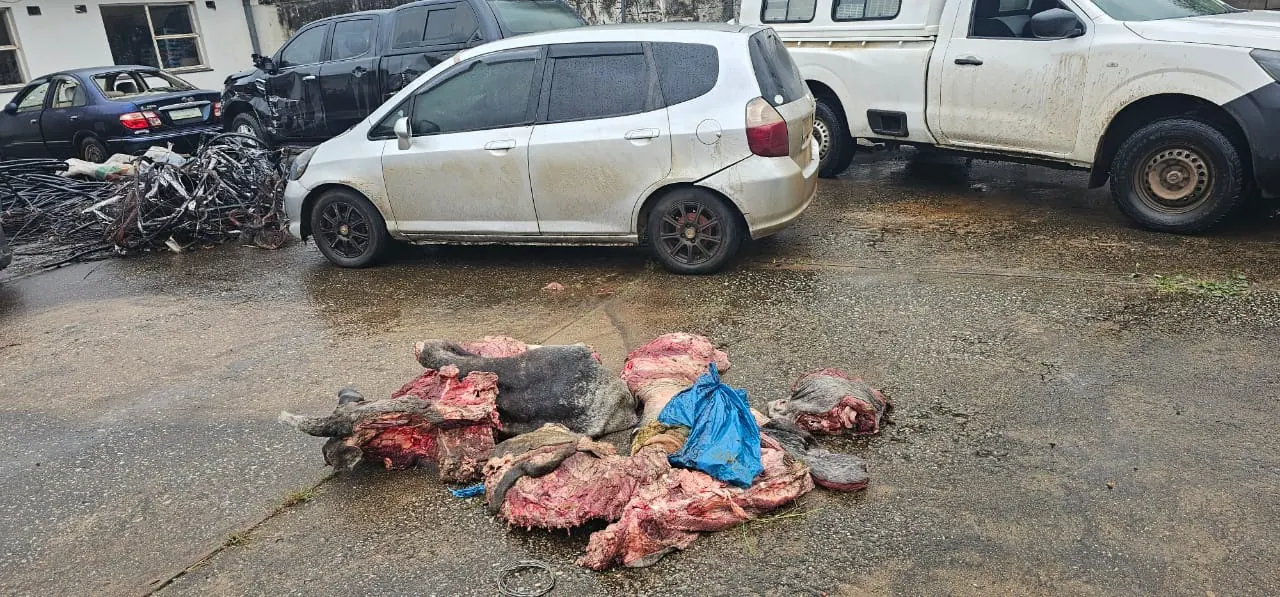
A 58-year-old man from Tincumatsini, Shewula, has been taken into custody by the Royal Eswatini Police Service (REPS) in connection with a stock theft case. The arrest was made on Monday at around 8:15 pm following an intelligence-led operation. The suspect is believed to have been involved in the abandonment of a Honda Fit with a cow carcass inside.
According to reports, traffic officers on patrol along the Maphiveni–Tabankulu public road on Sunday spotted a stationary Honda Fit with two occupants. When approached, the driver sped off, prompting a pursuit. The occupants later abandoned the vehicle in the Mhlume area and fled on foot. A search of the Honda Fit led to the discovery of a cow carcass in the back seat, which led to an investigation.
The REPS has commended the officers involved for their vigilance, commitment, and swift response. The 58-year-old suspect is expected to appear before the Siteki Magistrate’s Court. Police said the investigation is continuing, and the suspect could be linked to other stock theft cases. The second suspect remains at large.
Stock theft remains a significant challenge for Eswatini’s rural communities and livestock farmers, with stolen animals costing the country millions of Emalangeni. According to a report by the Times of Eswatini in December 2025, livestock worth more than E20.57 million was stolen between January and October that year. Cattle, goats, and pigs were among the animals most commonly targeted.
The impact of stock theft extends beyond the immediate value of animals lost. For many rural households, livestock represents a source of income, food, and financial security, meaning theft can wipe out years of investment. Authorities have also raised concerns about organised operations behind some stock theft cases, including an alleged cattle-theft syndicate accused of stealing livestock, slaughtering it clandestinely, and distributing the meat through illegal channels.
Cooperation between law enforcement agencies in Eswatini and neighbouring South Africa has become increasingly important, particularly because livestock can be moved across the shared border after being stolen. Stock theft has also complicated efforts to control livestock diseases, such as the 2025 foot-and-mouth disease outbreak, where authorities raised concerns about unauthorised movement of animals.
The consequences of livestock theft extend beyond individual farmers, affecting rural livelihoods, policing, disease control, and the wider livestock economy. The government estimated that a mass cattle vaccination programme could cost about E63 million, with approximately E40 million already spent on vaccines at the time.
Key points
- The suspect, a 58-year-old man from Shewula, Eswatini, was arrested for stock theft after abandoning a Honda Fit with a cow carcass inside.
- Stock theft costs Eswatini millions of Emalangeni annually, with livestock worth over E20.57 million stolen between January and October 2025.
- The incident highlights the need for cooperation between law enforcement agencies in Eswatini and South Africa to combat stock theft and organised crime.