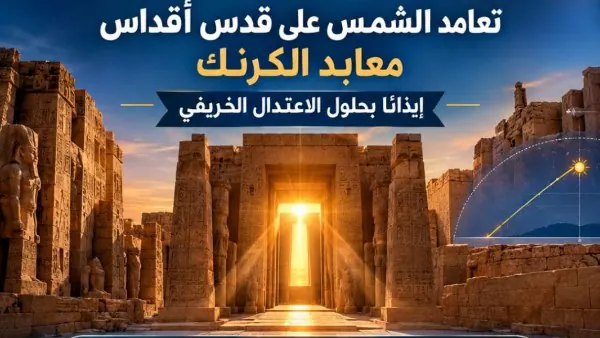
The Temple of Karnak in Luxor, Egypt, witnessed a rare astronomical phenomenon on Wednesday, September 23, 2026, as the sun's rays illuminated the inner sanctum of the temple, marking the beginning of autumn. This event, which occurs annually, showcases the ingenuity of ancient Egyptian architecture and its connection to astronomical sciences. According to Dr. Manar Abbadi, head of the Solar Research Laboratory, the phenomenon occurs when the sun's rays pass through the temple's architectural openings, illuminating the inner chambers.
The phenomenon, known as the "sun's alignment," occurs when the sun's rays enter the temple through specific openings, highlighting the ancient Egyptians' understanding of astronomy and architecture. Dr. Abbadi explained that the sun's elevation at noon will reach approximately 64 degrees, allowing the sun's rays to penetrate the inner sanctum and illuminate the chambers of the Ptah and Ramses III temples. This spectacle demonstrates the advanced knowledge of ancient Egyptians in astronomy and architecture.
The Temple of Karnak, one of the largest and most important religious complexes in ancient Egypt, was built on an east-west axis, aligning with the sun's path. This alignment reflects the ancient Egyptians' deep understanding of astronomy and its connection to their architectural designs. The Egyptian Ministry of Tourism and Antiquities has documented similar phenomena in the past, highlighting the significance of this event in showcasing the ingenuity of ancient Egyptian civilization.
The phenomenon coincides with the autumnal equinox, which marks the beginning of autumn in the Northern Hemisphere and spring in the Southern Hemisphere. According to the National Institute for Astronomical and Geophysical Research, the autumnal equinox is a significant astronomical event that marks the transition from summer to autumn. As the sun moves southward after the equinox, temperatures in the Northern Hemisphere begin to drop, signaling the onset of autumn.
The Temple of Karnak, located in Luxor, Egypt, is a vast complex of temples, halls, and sanctuaries built over several historical periods. The complex was a major religious center in ancient Thebes and features several impressive structures, including the Temple of Amun-Ra, the Great Hypostyle Hall, and the Sacred Lake. The ancient Egyptians referred to the complex as "Ipetsut," or "the most distinguished place," reflecting its importance as a spiritual center.
The phenomenon of the sun's alignment with the Temple of Karnak highlights the advanced knowledge of ancient Egyptian astronomers and architects. By designing the temple to align with the sun's path, the ancient Egyptians demonstrated their deep understanding of astronomical phenomena and their ability to incorporate this knowledge into their architectural designs. This event continues to fascinate visitors and scholars alike, offering a glimpse into the ingenuity and sophistication of ancient Egyptian civilization.
As the sun's rays illuminate the inner sanctum of the Temple of Karnak, visitors and enthusiasts gather to witness this rare phenomenon. The event has sparked significant interest in the region, with many people traveling to Luxor to experience the spectacle. The Egyptian Ministry of Tourism and Antiquities has taken steps to protect and preserve the site, ensuring that future generations can continue to marvel at the ingenuity and beauty of ancient Egyptian architecture.
Key points
- The Temple of Karnak in Luxor, Egypt, experiences a rare astronomical phenomenon as the sun's rays illuminate its inner sanctum, marking the beginning of autumn.
- The phenomenon showcases the advanced knowledge of ancient Egyptian astronomers and architects, who designed the temple to align with the sun's path.
- The event coincides with the autumnal equinox, marking the beginning of autumn in the Northern Hemisphere and spring in the Southern Hemisphere.