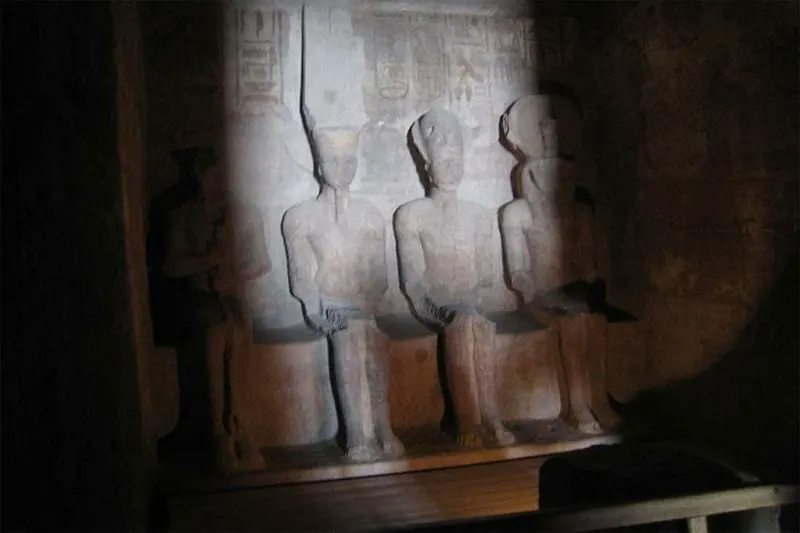
The Karnak temple complex in Luxor is set to witness a unique astronomical phenomenon on Wednesday, as the midday sun illuminates the sacred chambers of the Ptah and Ramesses III temples at noon, marking the autumn equinox. This event is a significant occurrence, as it highlights the ancient Egyptians' advanced understanding of astronomy and their ability to construct temples that served as precise timekeepers.
According to Ayman Abu Zeid, head of the Egyptian Association for Tourism and Archaeological Development, the sun's golden rays will pierce the darkness of the two sacred chambers, signaling the start of autumn. This phenomenon is a testament to Karnak's standing as one of the world's oldest astronomical observatories, with a history dating back over 4,000 years. The site has been used for tracking celestial movement, and its significance in ancient Egyptian astronomy cannot be overstated.
A study by Abu Zeid, presented at Luxor University's Third International Conference of the Faculty of Archaeology, found that Karnak's temples are closely linked to the four seasons of the ancient Egyptian year. The research focused on two sacred chambers inside the Ramesses III temple, which functioned as a "calendar clock." By tracking the sun's movement inside the chambers from June 21 to the autumn equinox, the study showed that the chambers registered both the end of summer and the start of autumn under the ancient Egyptian calendar.
The study's findings indicate that the ancient Egyptian year was structured as four three-month seasons, rather than the conventionally attributed three four-month seasons. This discovery counters earlier claims by some foreign scholars who denied that the ancient Egyptians recognized an autumn season. The research aims to strengthen Egyptian efforts to study ancient astronomy's ties to temple architecture and open new ground for understanding this relationship.
Karnak is one of the largest and most important religious complexes built in ancient Egypt, encompassing the main Amun-Re temple, the Great Hypostyle Hall, and the Sacred Lake, alongside smaller shrines such as those of Ptah and Ramesses III. The complex is also known for its solar event on December 21, when the rising sun penetrates the temple's inner sanctuary along its main east-west axis to mark the winter solstice, drawing large crowds of visitors annually.
Luxor, home to hundreds of tombs and dozens of temples and chapels built by ancient Egypt's kings, queens, and nobles, hosts a range of astronomical phenomena at its archaeological sites. Egyptian researchers have documented similar effects at various sites, including the Amun-Re sanctuary at Karnak, Medinet Habu, Deir El-Bahari, and the Temple of Isis at Deir Shelwit. A similar twice-yearly equinox alignment has also been recorded on the Giza Plateau, where the Sphinx and the Pyramids register the sun's shift each spring and autumn.
As Egypt's tourism sector continues to expand, with international arrivals climbing 16 percent in the first quarter of 2026 compared to the same period a year earlier, the country is preparing to host a total solar eclipse crossing the city and the Western Desert oasis of Siwa on August 2, 2027. The tourism ministry has formed a dedicated committee to coordinate logistics, transport, and site preparations for the event, which is expected to draw significant interest from astronomy enthusiasts and tourists alike.
Key points
- The Karnak temple complex in Luxor will experience a unique astronomical phenomenon on Wednesday, as the midday sun illuminates the sacred chambers of the Ptah and Ramesses III temples, marking the autumn equinox.
- A study by Ayman Abu Zeid found that Karnak's temples are closely linked to the four seasons of the ancient Egyptian year, and that the ancient Egyptian year was structured as four three-month seasons.
- Egypt's tourism sector is expanding, with international arrivals climbing 16 percent in the first quarter of 2026, and the country is preparing to host a total solar eclipse on August 2, 2027.