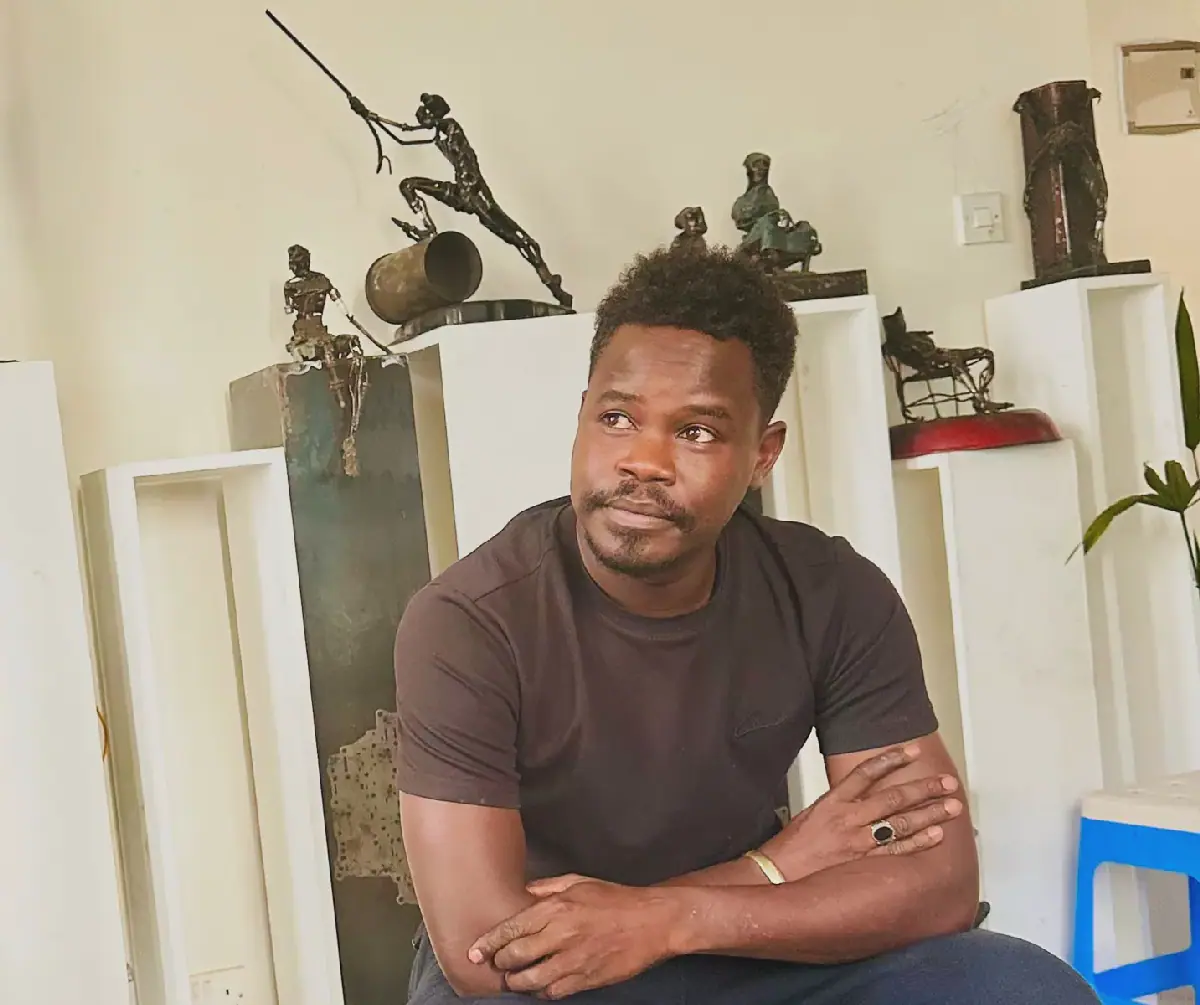
Sudanese artist and sculptor Adlan Yousif has found a way to transform the wreckage of war into works of art that carry memories of pain and tell stories of displacement, loss, and resilience. His artistic practice has taken shape around personal and collective memories burdened by war, with roots in his childhood in Darfur, where he lived through the events of 2003 and 2004. Yousif's work seeks to bring aesthetic and human value to the ruins, carrying messages of peace.
Yousif chooses scrap metal as the principal material for his sculptures, as it is a remnant of war that was once used to kill and displace people. He believes that this material can be transformed into a means of expressing tragedy and calling for peace. Yousif does not seek to conceal the material's harshness or erase its history; instead, he draws on its solid presence to express the fragility of human life in the face of violence.
The death of Yousif's mother in November 2025 was a painful turning point in his artistic journey, leaving a clear imprint on his sculptures and other works. He stopped working for nearly two months, and when he returned to art, he carried with him the memory of his mother and the pain of her absence. His work became a space to recall her image and document the stories of mothers whose lives have been touched by war.
Yousif's first solo exhibition, Deprivation, placed the experience of loss and displacement at the heart of his work. One of the exhibition's most striking pieces is a large painting dominated by an expanse of yellow, representing desertification, drought, and deprivation. At its centre is the face of a single child, set against the vastness of yellow, evoking the suffering of civilians, particularly children, amid forced displacement, hunger, and killing.
Sudanese women occupy a prominent place in Yousif's artistic practice, symbolizing generosity and resilience in the face of war and violations. One of his most notable works is a sculpture of a woman carrying burdens on her head, despite having lost a leg and an arm. The work portrays a woman physically exhausted by war, yet still able to give and continue living.
Yousif has created numerous artworks in opposition to war, including a piece that can be dismantled and reassembled, initially resembling the buttstock of a rifle before transforming into a microphone. He calls it The Buttstock, embodying the idea of turning instruments of war into tools for peace. His art serves as a voice for peace, drawing public attention to the horrific violations documented in his work.
Yousif's artwork has been recognized globally, with one of his sculptures permanently displayed at the Nairobi National Museum and featured in the 2025 edition of the Kenya calendar. His art gives women a central place in the story of the war, not simply as victims, but as a force capable of enduring and continuing to live despite the pain.
Key points
- Adlan Yousif uses scrap metal from war wreckage to create art that tells stories of displacement, loss, and resilience.
- His artwork often focuses on the experiences of Sudanese women during the war, portraying them as symbols of resilience and generosity.
- Yousif's art serves as a voice for peace, seeking to bring aesthetic and human value to the ruins of war.