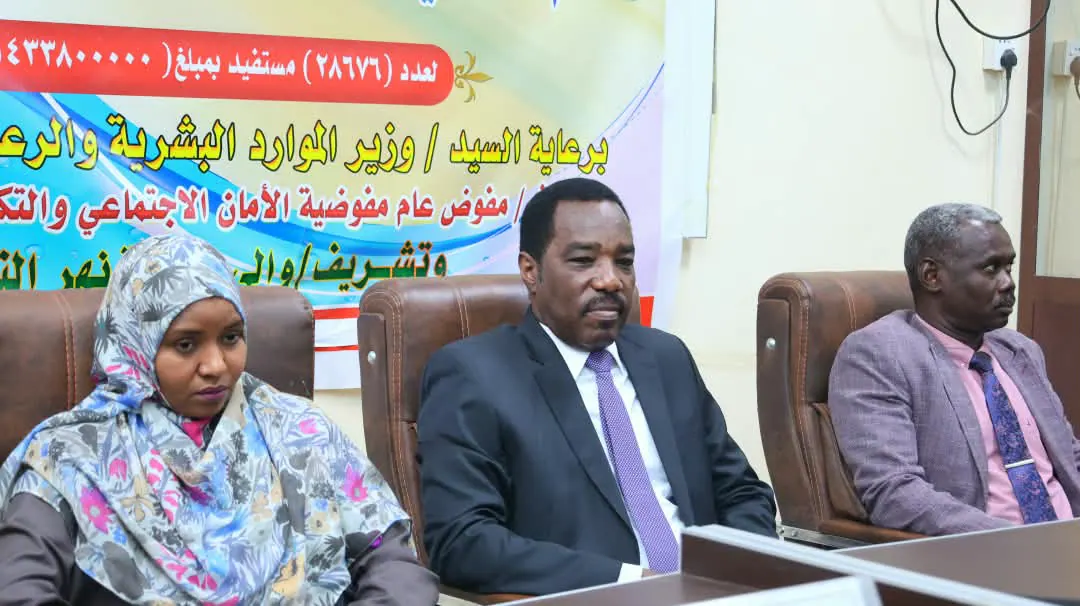
The government of Sudan's Nile River state has initiated a comprehensive social protection program, allocating 1.4338 billion Sudanese pounds ($1.4 billion) to support 28,676 vulnerable families across the state's seven localities. The program, launched by Minister of Human Resources and Social Care, Ma'tsam Ahmed Saleh, and Commissioner of the Social Safety Net and Poverty Reduction Commission, Dr. Mohamed Ali Salem, aims to provide direct cash assistance to the most needy families.
The program targets specific groups, including people with disabilities, orphans, families of martyrs, elderly citizens, female breadwinners, and the most vulnerable families. This initiative is part of the government's efforts to enhance social protection and alleviate living burdens on these groups. The program's design focuses on providing direct cash assistance as a primary tool for social protection.
However, the government is also shifting its approach to emphasize economic empowerment and livelihood projects, aiming to transition capable families from receiving support to becoming productive. This strategic shift seeks to enable families with the potential to work to move out of the support circle and into production. The government plans to concentrate support on families and individuals unable to produce.
Commissioner Dr. Mohamed Ali Salem emphasized the importance of coordination between the Social Safety Net and Poverty Reduction Commission, the Zakat Chamber, and the Social Development and Savings Bank at both federal and state levels. This coordination ensures that support reaches its intended recipients and that resources are available to the most in-need families.
The program's implementation involves developing new mechanisms for distributing support, including transitioning to direct cash disbursement and opening bank accounts for beneficiaries. Arrangements are being made to reach beneficiaries in remote areas, including those with disabilities who may face challenges accessing distribution points.
Minister Ma'tsam Ahmed Saleh and Commissioner Dr. Mohamed Ali Salem conducted a tour of social institutions in the state, assessing performance and challenges facing protection programs. They also visited several service projects, including educational and healthcare initiatives, aimed at improving living conditions and providing essential services to citizens.
Key projects visited included the Al-Shorouk schools in Damar, where efforts have been made to improve the educational environment, and the central laboratory of the National Health Insurance Fund in Atbara. Additionally, they launched the Abu Qsissa Health Center in the Berber locality, reflecting the government's commitment to decentralizing healthcare services and making them more accessible to the population.
Key points
- The program aims to support 28,676 vulnerable families across Nile River state's seven localities.
- The initiative focuses on providing direct cash assistance to people with disabilities, orphans, families of martyrs, elderly citizens, female breadwinners, and the most vulnerable families.
- The government plans to transition capable families from receiving support to becoming productive through economic empowerment and livelihood projects.