Sudan's military has denied allegations made by Ethiopian army chief Field Marshal Birhanu Jula that Khartoum is backing armed groups fighting in the country's north. In a statement, the Sudanese armed forces said they "categorically reject these allegations and consider them baseless", adding that Sudan is "committed to international law and the principles of good-neighbourly relations". The allegations were made on Sunday, as fighting escalated in the northern Tigray state.
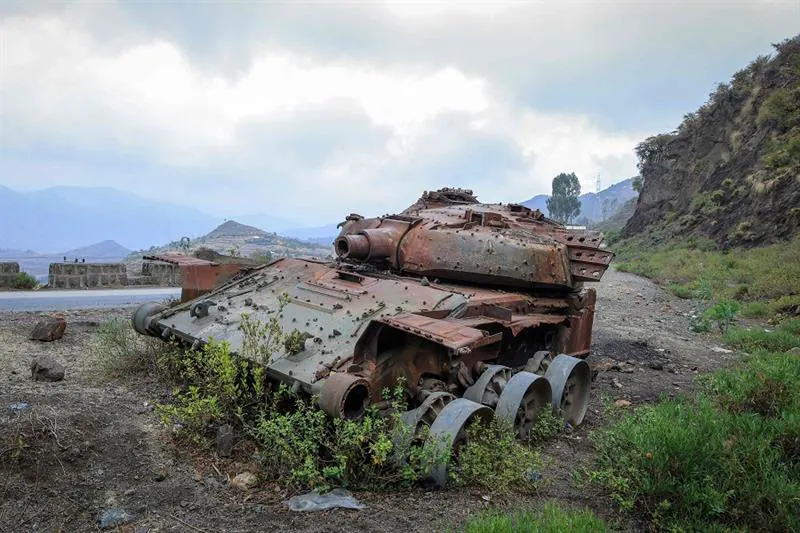
The renewed fighting between the Tigray People's Liberation Front (TPLF) and Ethiopia's federal government has stoked fears of a return to a conflict that killed more than 600,000 people between 2020-2022, according to African Union estimates. Tensions have been rising for months between Ethiopia's federal government and authorities in the state. The conflict has led to a significant humanitarian crisis, with thousands of people displaced and many more affected.
Ethiopian army chief Field Marshal Birhanu Jula accused Sudan, Egypt, and Eritrea of supporting forces battling the federal government. He claimed that these external forces were backing the TPLF and other groups, allowing them to continue fighting. However, Sudan's military has denied any involvement, and Egypt and Eritrea have not publicly responded to the allegations.
The conflict in Ethiopia is not the only issue affecting the region. Sudan's military has also accused Ethiopia of supporting the paramilitary Rapid Support Forces (RSF), its foe in a war at home that has raged since April 2023. Khartoum has repeatedly accused Ethiopia of allowing drone attacks to be launched from its territory in coordination with the United Arab Emirates, allegations that both Addis Ababa and Abu Dhabi deny.
In May, Ethiopia accused the Sudanese army of backing TPLF-linked "mercenaries", a charge Khartoum denied. The tensions between Sudan and Ethiopia have been escalating, with both countries trading accusations and denying any wrongdoing. The situation remains volatile, with fears of further conflict and humanitarian crises.
The international community is closely watching the situation, with concerns about the impact on regional stability. The conflict in Ethiopia has already had significant humanitarian consequences, and further escalation could have far-reaching effects. Sudan's rejection of Ethiopia's allegations has helped to reduce tensions, but the situation remains fragile.
The conflict in Tigray has also had economic implications, with Ethiopia's economic recovery at risk due to the ongoing fighting. The situation is being closely monitored by international organizations and governments, which are urging restraint and a peaceful resolution to the conflict. Key efforts are needed to address the humanitarian crisis and prevent further escalation.
Key points
- Sudan's military rejects Ethiopia's allegations of supporting armed groups fighting in Tigray.
- The conflict in Ethiopia has stoked fears of a return to a devastating civil war that killed over 600,000 people.
- The situation remains volatile, with tensions between Sudan and Ethiopia escalating and fears of further conflict and humanitarian crises.