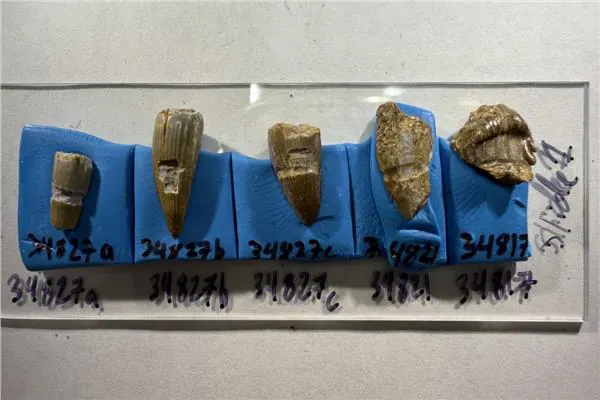
A recent scientific study has revealed that dinosaurs and other terrestrial animals exploited marine resources that washed ashore during the Cretaceous period, which spanned from approximately 145 to 66 million years ago. The study, published in the journal Frontiers in Ecology and Evolution, provides evidence that marine resources were incorporated into the food web of animals living in coastal areas. This phenomenon is similar to what occurs in modern coastal ecosystems, where organic matter from the sea can provide an additional food source for terrestrial animals.
The research team analyzed the carbon isotopes present in the tooth enamel of dinosaurs and other animals that lived during the Cretaceous period. By measuring the ratio of carbon-12 and carbon-13, the researchers were able to compare the chemical signatures of different animals and determine the sources of their food. The results showed that animals living in coastal areas had a distinct chemical signature compared to those living in inland areas, indicating that they had access to marine resources.
The study focused on fossils from the Western Interior Seaway, a large inland sea that divided much of North America during the Cretaceous period. The researchers also analyzed fossils from the Gulf of Mexico coast. The results showed that the carbon isotope values in fossils from coastal areas were higher than those from inland areas, suggesting that marine resources were being transferred to terrestrial food webs.
The study's findings suggest that marine resources were not only available to coastal animals but also played a role in the diets of some dinosaurs. However, not all dinosaurs relied on marine resources, as evidenced by the example of the herbivorous dinosaur Tenontosaurus. The study's results highlight the complexity of ancient food webs and the interconnectedness of marine and terrestrial ecosystems.
The research team also analyzed fossils of other animals, including fish, crocodiles, and turtles, which provided insight into the transfer of carbon between different trophic levels. The results suggest that marine carbon was introduced into the food web at a relatively low trophic level, allowing it to be transferred to a wide range of animals.
The study's findings have implications for our understanding of the evolution of life on Earth. The transfer of resources between marine and terrestrial ecosystems is not a recent phenomenon but has been occurring for hundreds of millions of years. The study's results also highlight the importance of considering the interconnectedness of different ecosystems when studying ancient life.
The researchers plan to expand their study to other geological periods, including the Early Jurassic and parts of the Cenozoic era. They also hope to obtain data from polar and equatorial regions to investigate whether the use of marine resources varied with climate and geographic location.
Key points
- The study provides evidence that dinosaurs and other terrestrial animals utilized marine resources washed ashore during the Cretaceous period.
- The research team analyzed carbon isotopes in tooth enamel to determine the sources of food for ancient animals.
- The study's findings highlight the complexity of ancient food webs and the interconnectedness of marine and terrestrial ecosystems.