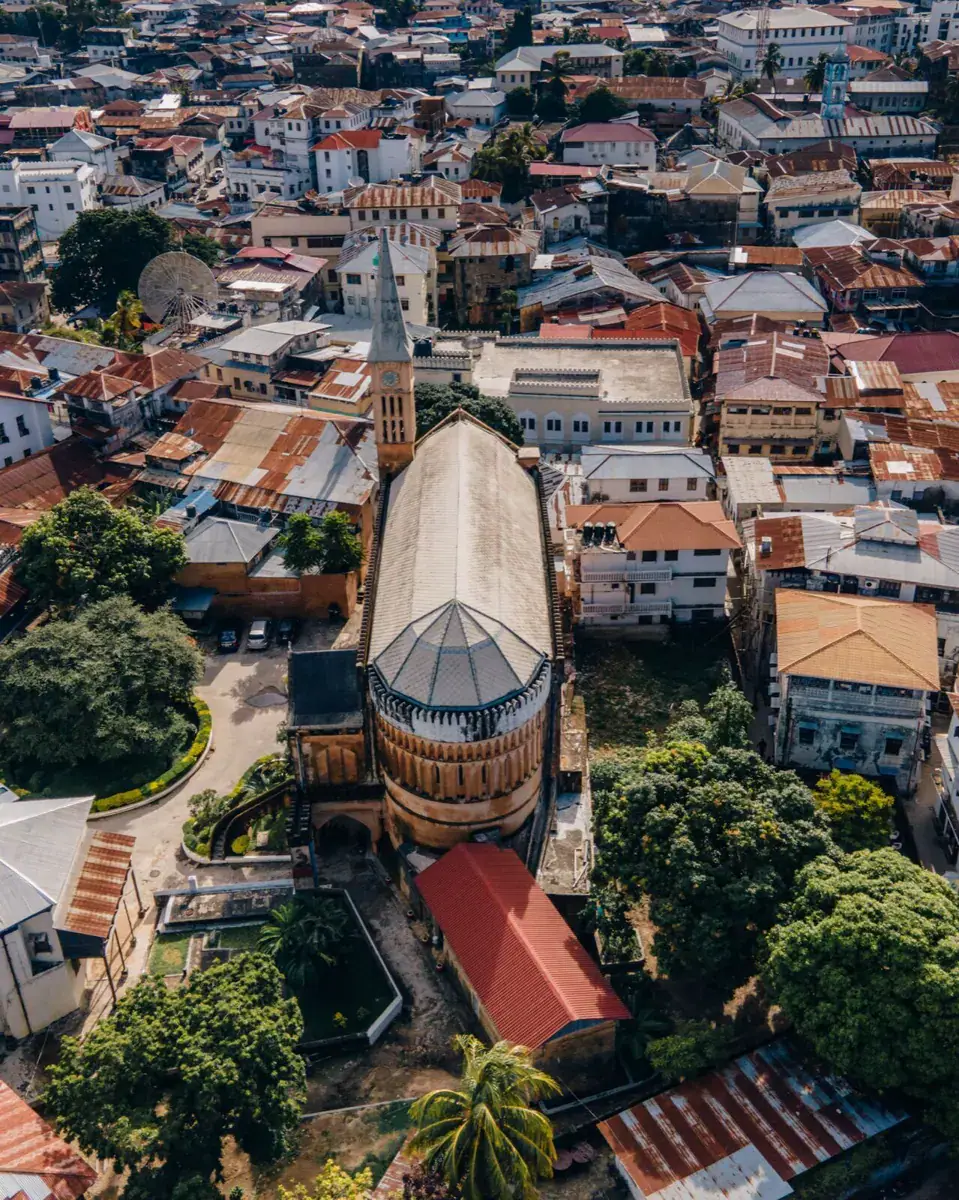
Stone Town, the old city quarter of Zanzibar City, is a dense, maze-like settlement of coral-stone buildings that has barely changed shape since the 19th century. Inscribed as a UNESCO World Heritage Site in 2000, it covers roughly 1.0 km² and sits on the western coast of Unguja, the main island. The town's character is a physical record of the powers that ruled Zanzibar, including Shirazi and Swahili traders, the Portuguese, the Omani Sultanate, and British colonial administration. Each of these powers left their mark on the town's architecture, resulting in a unique blend of styles.
The town's architecture is a testament to its rich history, with Portuguese remnants under Omani buildings, Indian merchant houses with deep carved doorways, Swahili coral-stone alleyways, and Victorian-era government buildings on the seafront. The result is unlike anywhere else in East Africa. Visitors can explore the town's many historical sites, including the Anglican Cathedral, the Old Fort, the Palace Museum, and the Forodhani Gardens. The town's narrow alleys and bustling markets offer a glimpse into its vibrant culture and history.
The Anglican Cathedral, built between 1873 and 1879, is a significant historical site, as it was deliberately built on the site of the last open-air slave market, which was closed by British pressure in 1873. The altar stands over the exact spot where the main slave auction block stood, and the altar is built lower than the nave floor to mark this. The slave memorial sculpture, created by Swedish artist Clara Sörnäs in 1998, is beneath the altar and features five horizontal figures in shackles, carved in stone.
The Old Fort, built between 1698 and 1701 by the Omani Arabs, is another significant historical site. It was built using the ruins of a Portuguese chapel as its foundation, and it hosted the Omani Sultanate's capital when Sultan Said bin Sultan moved it from Muscat to Stone Town in the 1830s. This marked the beginning of Stone Town's golden age of construction and its role as the Indian Ocean's dominant trading port. Zanzibar was the world's largest clove producer by the 1870s, and the Sultanate's wealth built the House of Wonders and most of Stone Town's grandest architecture.
Stone Town is also known for its over 500 documented carved wooden doors, one of the densest concentrations of decorative carved woodwork in the world. The doors are a visible physical record of who built the city and where their traditions came from. Two main styles exist: Omani/Arabic and Indian/Gujarati. The Omani/Arabic style features square-topped doorframes, more restrained carving, and chain and geometric patterns, while the Indian/Gujarati style features arched tops, elaborate surface carving, and brass studs.
Visitors to Stone Town can explore the town's many historical sites, take a walking tour, or simply wander through its narrow alleys and bustling markets. A guided walk, which includes entry to the Anglican Cathedral, costs approximately USD 3-5. The town's night market, which takes place in the Forodhani Gardens, offers grilled seafood, Zanzibar pizza, and Urojo soup, and is a great place to try local cuisine.
In addition to its rich history and culture, Stone Town is also a great base for exploring the surrounding area. Visitors can take a boat trip to Prison Island, which is home to Aldabra giant tortoises and offers good snorkelling opportunities. The island was built as a slave holding facility but functioned primarily as a British quarantine station after 1893. As of November 2024, visitors are no longer allowed to touch or feed the tortoises, as part of a conservation policy update.
Key points
- Stone Town is a UNESCO World Heritage Site with a rich history and unique architecture.
- The town has over 500 documented carved wooden doors, one of the densest concentrations of decorative carved woodwork in the world.
- Visitors can explore the town's many historical sites, take a walking tour, or simply wander through its narrow alleys and bustling markets.
Reporting sources
- Stone Town, Zanzibar: Visitor Guide · WildToSea