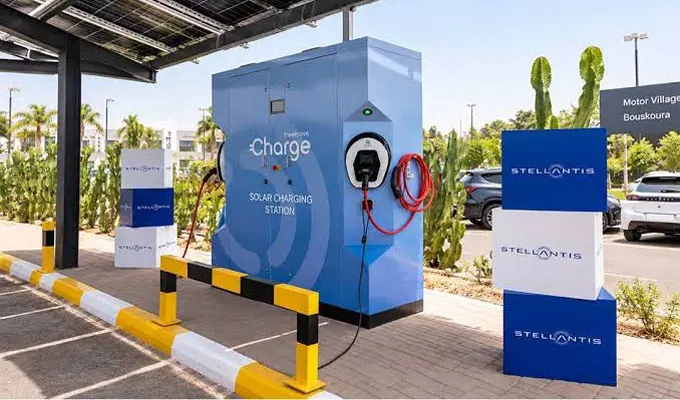
Automaker Stellantis has launched a one-year pilot project in Bouskoura, Morocco, to test a solar-powered charging station for electric vehicles. The station, developed in partnership with local company Solar Power, features a photovoltaic canopy, a storage system, and four alternating current charging points. This setup allows for the charging of up to eight plug-in hybrid vehicles or three fully electric vehicles daily. The station also includes two 230-volt domestic outlets for micromobility usage.
The solar-powered charging station is designed to operate off-grid, making it suitable for remote or underserved areas. The storage system utilizes reused batteries from Stellantis' micromobility vehicles, allowing for excess energy to be stored and used when solar production is low or interrupted. This innovative approach aims to provide a decentralized charging solution, potentially opening up new opportunities for electric vehicle adoption in areas with limited access to traditional energy infrastructure.
The pilot project will run for 12 months, during which time Stellantis and its partner will monitor the station's performance, gather user feedback, and assess the overall feasibility of the technology. The results of the pilot will help determine whether this solar-powered charging station can be a viable solution for widespread adoption. Key performance indicators, such as the station's investment costs, energy delivery costs, and storage capacity, have not been publicly disclosed.
Stellantis' Star*Up program is behind the development of this solar-powered charging station, which showcases the company's commitment to innovative and sustainable mobility solutions. By leveraging solar power and reused batteries, Stellantis aims to reduce the carbon footprint of its electric vehicles and provide a more environmentally friendly charging option.
The Bouskoura pilot project is a significant step towards developing a decentralized charging infrastructure, which could be particularly beneficial for regions with limited access to traditional energy grids. Solar Power, the partner company, has expressed interest in using the pilot's results to inform potential future deployments.
While the pilot project has garnered attention for its innovative approach, several key details remain undisclosed. The cost of investment, energy delivery costs, and storage capacity have not been made public, nor have specific targets for return on investment been set. The performance and longevity of the reused batteries in this second-life application also remain to be seen.
The success of this pilot project will depend on various factors, including user adoption, energy production, and overall system efficiency. If the results are positive, Stellantis and Solar Power may consider expanding this technology to other locations, potentially paving the way for a more sustainable and decentralized electric vehicle charging infrastructure.
Key points
- The solar-powered charging station can operate off-grid, making it suitable for remote or underserved areas.
- The station can charge up to eight plug-in hybrid vehicles or three fully electric vehicles daily.
- The project aims to assess the feasibility of decentralized charging solutions and gather data on user adoption and system performance.