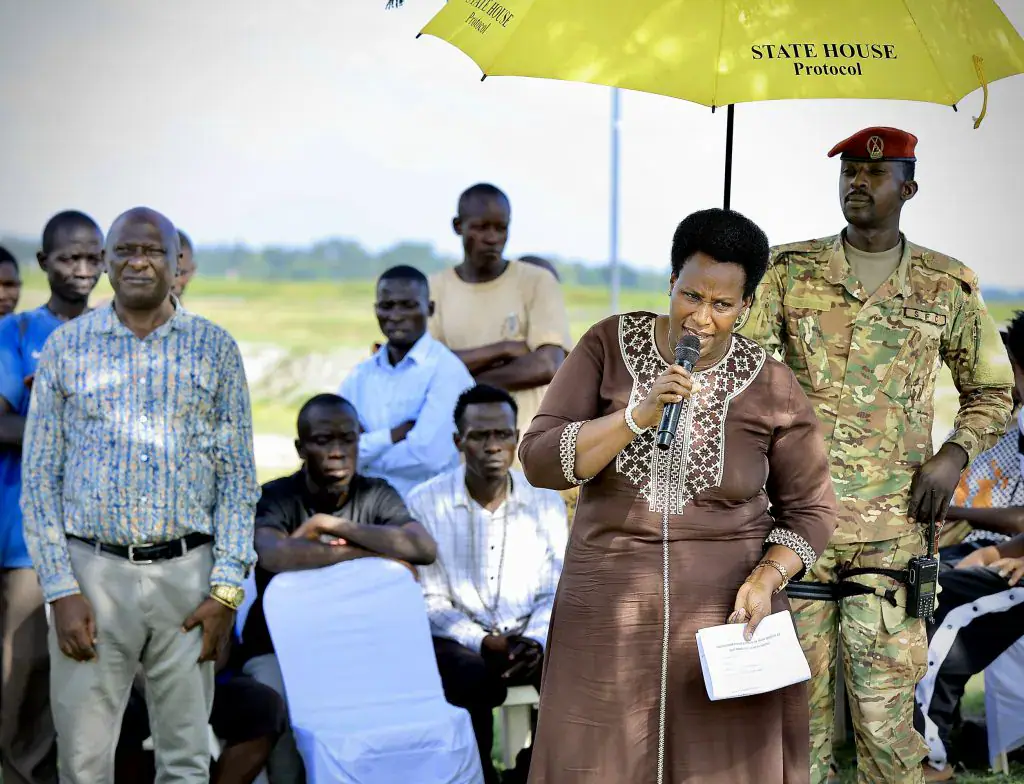
The initiative, championed by President Yoweri Kaguta Museveni, aims to restore degraded wetlands while providing communities with profitable alternative livelihoods through commercial fish farming. State House Comptroller, Ms. Jane Barekye, announced the pledge during a ceremony at Kaitambiri Village, where 1,000 iron sheets were distributed to 25 selected households. The iron sheets were purchased using proceeds from the group's first fish harvest.
The 79-member Kaitambiri Fish Farmers Group recently generated more than Shs82m from the sale of catfish harvested from just two of the 13 fish ponds established with support from State House. The project was initiated following President Museveni's concerns over widespread wetland degradation in the Bukedi sub-region, where communities had increasingly encroached on wetlands to cultivate rice. State House excavated 13 fish ponds on land previously used for rice cultivation and provided fish feeds for seven months.
Addressing the farmers during the distribution ceremony, Ms. Barekye commended them for embracing President Museveni's advice to abandon wetland rice cultivation and adopt more sustainable and profitable economic activities. She said the success of the initial harvest had demonstrated the potential of the President's intervention in transforming rural livelihoods through practical agricultural enterprises. Ms. Barekye pledged that State House would provide additional fingerlings and feeds to stock all the 13 ponds before the end of the year.
Ms. Barekye cautioned the farmers that the next production cycle would be the final phase of direct State House support, urging them to prepare to sustain and expand the enterprise independently. The 25 families to benefit from housing support will receive labour from State House towards the construction of permanent houses, while the beneficiaries will be responsible for mobilising funds and purchasing the required construction materials.
Dr. Morris Ochen, the Commissioner in Charge of Technology Transfer and Presidential Demonstration Farms at State House, said the pilot project had exceeded expectations, demonstrating the profitability of commercial fish farming. He said the farmers harvested the fish about three weeks ago and sold each kilogramme at Shs7,500, generating more than Shs82m in gross revenue. The project demonstrated that environmental conservation could go hand in hand with wealth creation, improved household incomes and better living conditions.
Despite the project's success, members of the Kaitambiri Fish Farmers Group called for additional infrastructure and equipment to improve production, reduce operational costs and access wider markets. They requested a refrigerated vehicle to transport harvested fish to distant markets, a fish-feed processing mill to lower production costs, fencing around the ponds to strengthen security and a permanent store for keeping feeds and other farm inputs.
In response, Ms. Barekye pledged to facilitate the provision of a vehicle, construction of a feed store and fencing of the fish ponds. Pallisa Resident District Commissioner, Mr. Majid Dhikusooka, said sustained sensitisation had helped change community attitudes towards wetland conservation, with more residents embracing alternative economic activities after witnessing the success of the Kaitambiri project.
Key points
- The Kaitambiri project serves as a demonstration model for other communities seeking to balance environmental conservation with the need to improve household incomes.
- State House has pledged to support the construction of 25 houses for vulnerable families in Kaitambiri Village, Pallisa District.
- The project generated more than Shs82m from the sale of catfish harvested from just two of the 13 fish ponds established with support from State House.