The Standard Bank has predicted that Mozambique will undergo a macroeconomic adjustment in 2027, driven by fiscal pressures, foreign exchange market imbalances, and a slow recovery of economic activity. According to the bank's chief economist, Fáusio Mussá, this adjustment is inevitable, regardless of whether Mozambique secures a financing program with the International Monetary Fund (IMF). The adjustment will require fiscal consolidation and structural reforms to restore macroeconomic stability and create conditions for more sustainable and inclusive growth.
The IMF had previously assessed Mozambique's public debt as unsustainable under current policies in a report published in February 2026. Fáusio Mussá emphasized that progress in fiscal consolidation is crucial to improving the state's financing conditions. He also advocated for greater exchange rate flexibility due to the scarcity of foreign currency and its implications for economic activity and investment outside the natural resources sector.
The Standard Bank projects that Mozambique's economy will maintain a slow recovery in 2027, with growth expected to reach around 2.3%, which is lower than the estimated population growth rate of 2.7%. This growth rate is insufficient to significantly generate employment and reduce poverty. In the medium term, the bank expects the progress of liquefied natural gas (LNG) projects in the Rovuma Basin to boost economic growth to two-digit rates from the last quarter of 2028.
However, this growth is not expected to immediately translate into a substantial increase in state revenues or job creation. Therefore, structural reforms that promote economic diversification and more inclusive growth are necessary. Fáusio Mussá noted that the seeds for this more inclusive growth still need to be sown and that reforms in this direction may occur next year.
The Standard Bank also expects global economic tensions and conflicts to persist in the short term, particularly in the Middle East, which may maintain pressure on fuel and fertilizer prices, food prices, and inflation. Despite these constraints, the global economic growth is expected to remain resilient, ranging between 3% and 3.4%, although risks of deceleration persist.
Agnaldo Mavera, the interim CEO of Standard Bank, highlighted the importance of cooperation among different economic stakeholders to address the country's challenges. He emphasized the role of dialogue in identifying solutions and development opportunities. The bank's role goes beyond offering banking products and services, including sharing knowledge, understanding client challenges, and supporting investment and growth decisions.
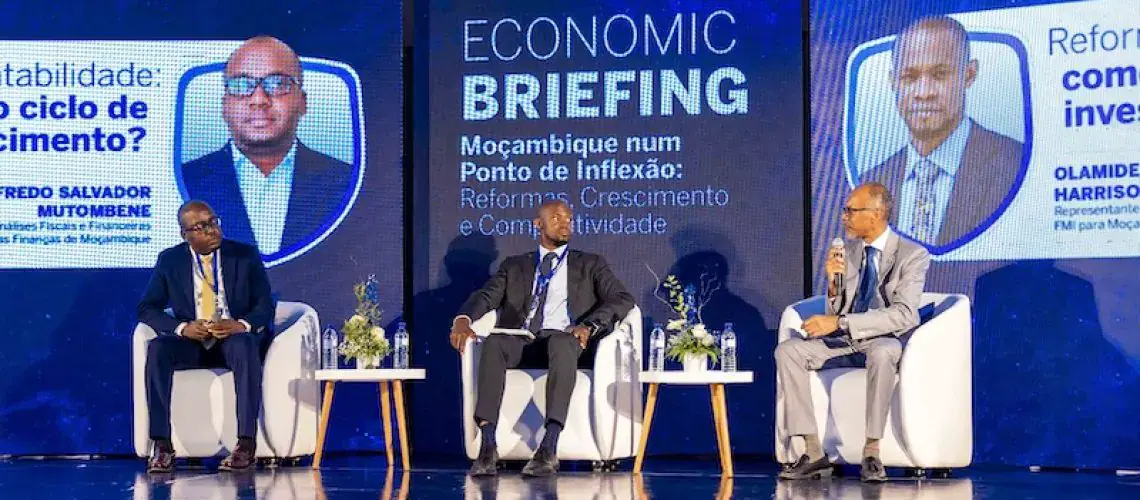
The 23rd edition of the Standard Bank's Economic Briefing, themed "Mozambique at a Turning Point: Reforms, Macroeconomic Stability, and Conditions for Growth," featured a panel discussion with government representatives, IMF officials, and business associations. The discussion focused on fiscal reform, public finance sustainability, and conditions for a new investment cycle.
Key points
- The Standard Bank predicts Mozambique's macroeconomic adjustment in 2027 due to fiscal pressures and economic activity recovery.
- The adjustment will require fiscal consolidation and structural reforms to restore macroeconomic stability and create conditions for more sustainable and inclusive growth.
- The progress of LNG projects in the Rovuma Basin is expected to boost economic growth to two-digit rates from the last quarter of 2028.