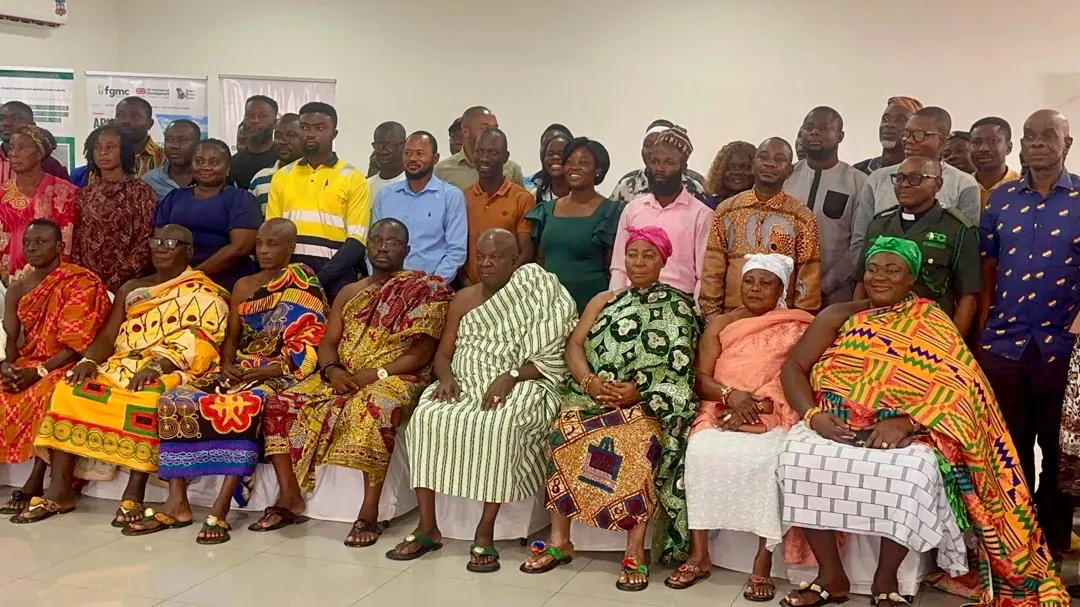
Stakeholders in the Ahafo Region of Ghana have expressed disappointment in law enforcement agencies and state regulatory bodies for their failure to curb rampant illegal mining activities, particularly those driven by foreign nationals. This concern was raised during a Regional Multi-Stakeholder Mining Forum held in Goaso, organised by the Nature and Development Foundation (NDF) in collaboration with the Forestry Commission, the Environmental Protection Authority (EPA), and the Minerals Commission.
The forum disclosed that six foreign-owned companies, predominantly operated by Chinese nationals, are currently engaging in illegal mining operations across the region, with only one holding a valid legal permit. The presence and active operation of foreign nationals in illegal mining constitute direct violations of several statutory laws in Ghana.
Under the Minerals and Mining Act, 2006 (Act 703) as amended by Act 995 in 2019, small-scale mining is strictly reserved for Ghanaian citizens, making non-citizen participation a severe criminal offence under Section 99. Furthermore, operating without approved Environmental Impact Assessments breaches the Environmental Protection Agency Act, 1994 (Act 490), while the direct discharge of chemical waste into public rivers violates the Water Resources Commission Act, 1996 (Act 522).
These illegal operations also actively undermine key international commitments under the United Nations Sustainable Development Goals (SDGs). The destruction directly sabotages SDG 3 (Good Health and Well-being) and SDG 6 (Clean Water and Sanitation) by contaminating essential community water sources with toxic waste.
Additionally, the widespread deforestation compromises SDG 13 (Climate Action) and SDG 15 (Life on Land) by stripping forest carbon sinks and destroying terrestrial fauna, while defying SDG 12’s call for responsible consumption and resource management. Beyond regulatory breaches, the environmental degradation poses severe risks to livelihoods and public health.
Land degradation renders vast tracts of cocoa and food crop farms infertile, stripping farmers in the region of their main source of income and threatening regional food security. The unregulated runoff of heavy metals like mercury and cyanide leads to chronic kidney damage, neurological disorders, and respiratory illnesses among residents, while heavy siltation destroys aquatic life and destabilises entire river ecosystems.
Speaking at the event, NDF Regional Coordinator Glen Asomaning emphasised that the platform was designed to foster practical dialogue among key actors to halt forest destruction and enforce statutory compliance. At the end of the forum, stakeholders formulated a unified action plan, urging state institutions and security agencies to enforce statutory laws without compromise.
Key points
- The Ahafo Region forum was organised by the Nature and Development Foundation (NDF) in collaboration with the Forestry Commission, the Environmental Protection Authority (EPA), and the Minerals Commission.
- Six foreign-owned companies, predominantly operated by Chinese nationals, are currently engaging in illegal mining operations across the region.
- The destruction directly sabotages SDG 3 (Good Health and Well-being) and SDG 6 (Clean Water and Sanitation) by contaminating essential community water sources with toxic waste.