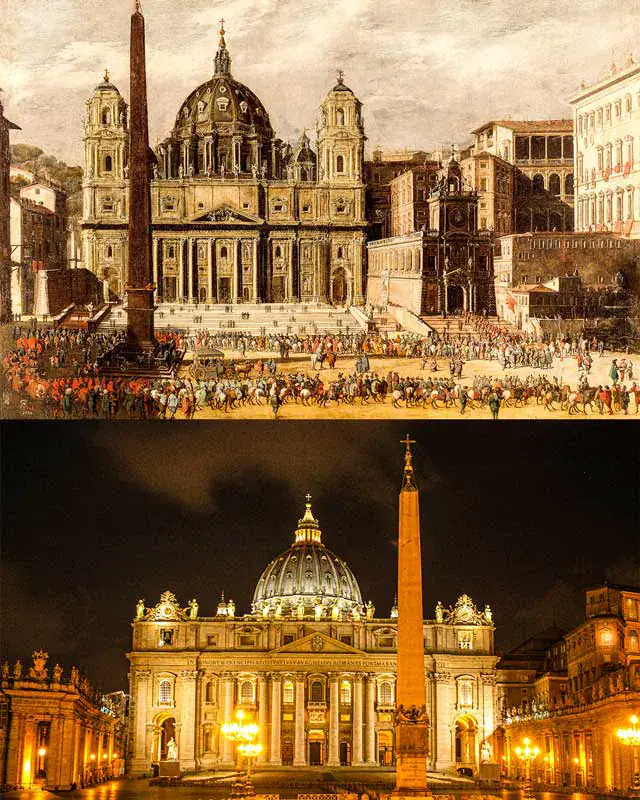
St Peter's Basilica in the Vatican is celebrating a significant milestone - its 400th anniversary. On November 18, Pope Leo XIV will celebrate a solemn Mass in the basilica to mark the exact 400th anniversary of its consecration by Pope Urban VIII in 1626. This event inspires both awe and reflection, given the basilica's rich history and the ambitious project that led to its construction. The story of St Peter's begins in the first century AD, when the Apostle Peter was martyred and buried on the Vatican Hill.
The construction of the first giant basilica over Peter's tomb began around 320 under Emperor Constantine, who had recently become sympathetic to Christianity. This huge, five-aisle structure stood for over a thousand years before it began to crumble by the 15th century. In 1505, Pope Julius II decided to demolish the ancient basilica and build a new one, a decision met with much opposition. Despite this, construction of the new St Peter's commenced in 1506, overseen by renowned architects such as Bramante, Raphael, Michelangelo, and Bernini.
The design of the new basilica was a collaborative effort spanning over a century, reflecting the transition from Renaissance to Baroque styles. Donato Bramante initially drew up plans for a grand Greek-cross design topped with a vast dome. After Bramante's death in 1514, Raphael and Antonio da Sangallo the Younger took over briefly. In 1546, Michelangelo, then 71 years old, was appointed chief architect. He simplified Bramante's design and created the iconic dome that defines Rome's skyline.
Michelangelo's dome, rising 136m high, became a model for numerous subsequent structures worldwide. Despite his significant contributions, Michelangelo died before the basilica's completion. Construction was finally completed in 1615, and Gian Lorenzo Bernini later added the colonnaded piazza and the dramatic bronze baldachin over the high altar. However, the basilica's construction was not without controversy, as the papacy's aggressive fundraising schemes, including the selling of indulgences, led to the Reformation.
The selling of indulgences, introduced by Julius II and promoted by Leo X, was a contentious issue that pushed Martin Luther to publish his "95 Theses" in 1517, marking the beginning of the Reformation. This event led to a split in Western Christianity and subsequent blood-soaked wars. St Peter's has been the principal ceremonial church of the papacy for centuries, hosting numerous significant events, including coronations, inaugurations, and burials of popes.
The basilica has also been the scene of two Church councils, the First Vatican Council (1869-70) and the Second Vatican Council (1962-65). The First Vatican Council defined the doctrine of papal infallibility, while the Second Vatican Council met in St Peter's basilica for sessions that lasted several weeks. In 1972, a disturbed Australian man attacked Michelangelo's Pietà with a hammer, damaging the Virgin Mary's face and arm.
St Peter's Basilica is the world's largest church, covering 23,000m2 of floor space and capable of holding up to 60,000 people. The dome's massive weight required iron chains to be wrapped around its base to prevent cracking. Today, St Peter's continues to be a significant place of worship and a symbol of the Catholic Church. Cardinal Mauro Gambetti, archpriest of St Peter's basilica, has emphasized that the anniversary is not just a historical jubilee but also an opportunity for reflection and spiritual growth.
Key points
- St Peter's Basilica celebrates its 400th anniversary with a solemn Mass by Pope Leo XIV.
- The basilica's construction was a collaborative effort by renowned architects over a century.
- The basilica's history is marked by controversy, including the selling of indulgences that led to the Reformation.
Reporting sources
- 400 years of St Peter’s Basilica · The Southern Cross