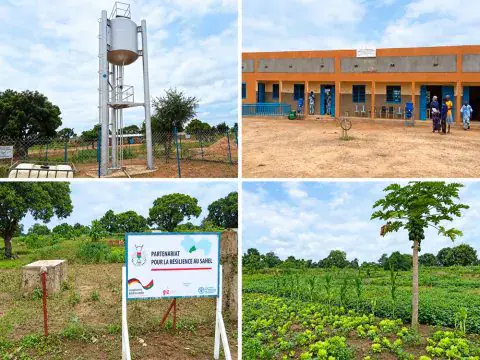
The Sahel Resilience Partnership (SRP) is an initiative implemented under the leadership of the Burkinabé government, with the support of the German government, the World Food Programme (WFP), the German Development Cooperation (GIZ), and the United Nations Children's Fund (UNICEF). The program aims to strengthen resilience in several regions, including Goulmou, by addressing the challenges of food insecurity, climate change, access to basic social services, and social cohesion.
The SRP operates in five regions, including Yaadga, Koulsé, Oubri, Goulmou, and Nakambé, covering 62 resilience sites in 28 communes. The program's approach is based on complementarity between the interventions of the WFP, UNICEF, and GIZ, which are organized around four complementary pillars: resilient social services, food and nutritional security, resilient ecosystems, and social cohesion.
In the Goulmou region, specifically in Fada N'Gourma, the SRP has implemented several projects, including a 2-hectare market garden and a 5-hectare rice-growing area, which are managed by households that have been supported in developing their productive capacities. The initiative has also included the restoration of land, access to water, sanitation, training, provision of agricultural inputs and equipment, livestock, and infrastructure.
According to the SRP's achievements, over 1.1 million people have seen their resilience strengthened. In the area of food and nutritional security, 5,900 agricultural producers have been supported, 360,000 people have been lifted out of malnutrition, 18,000 children have benefited from school canteens, and over 240,000 people have been reached by nutritional interventions.
The SRP has also made significant progress in the area of resilient ecosystems, with 6,400 hectares of land restored, 62,000 m3 of compost and bio-inputs produced, 11,000 tons of seeds distributed, 10,000 improved stoves disseminated, and over 520 resilient infrastructures built. In the area of resilient social services, 550,000 people have been reached, 150,000 women have benefited from better access to health and nutrition services, and 10,000 children and families have benefited from protection and psychosocial support services.
The SRP's approach is centered on the principle of not bringing pre-made solutions, but rather developing approaches in close collaboration with Burkinabé partners and adapting them to the context and identified needs. The program's vision is to support communities towards sustainable resilience, strengthening their capacity to anticipate, absorb, and overcome climate, security, and socio-economic shocks.
A joint team from GIZ, WFP, and UNICEF recently visited Fada N'Gourma to assess the impact of the SRP's actions and discuss the program with local authorities. The visit highlighted the progress made in the region, including the implementation of a market garden and a rice-growing area, as well as improvements in education and healthcare.
Key points
- The SRP has improved the lives of over 1.1 million people in Burkina Faso's Goulmou region.
- The program's approach is based on complementarity between the interventions of the WFP, UNICEF, and GIZ.
- The SRP has made significant progress in the areas of food and nutritional security, resilient ecosystems, and resilient social services.