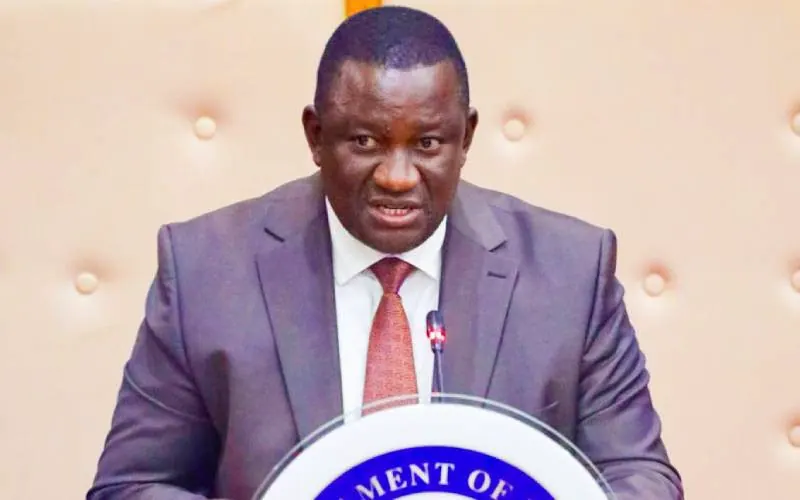
Cabinet Secretary for Youth Affairs, Creative Economy and Sports Salim Mvurya has acknowledged that young people in Kenya's creative and sports industries are confronting a range of challenges. These challenges include financial insecurity, intense public scrutiny, limited career opportunities, mental health pressures, and uncertainty over life after retirement. Mvurya noted that these issues can have a significant impact on the well-being of young creatives and athletes.
Mvurya stated that young creatives in Kenya face pressure to remain relevant in an increasingly competitive industry. This pressure can be compounded by cyberbullying, loss of privacy, repeated rejection, and unstable incomes. He also noted that athletes face the demands of high-level competition, injuries, short careers, and questions about their welfare once they leave active sport. The CS emphasized that the mental health and overall well-being of citizens, particularly young creatives, remains a strategic priority for the Government.
The Government has outlined measures to address some of these concerns. These measures include mental health support for creatives, improved welfare programmes for athletes, preservation of Kenya's sporting heritage, and stronger youth empowerment initiatives. Mvurya noted that creatives operate in an environment that can expose them to financial uncertainty, intense social media scrutiny, cyberbullying, loss of privacy, high rejection rates, and pressure to remain relevant.
Mvurya also acknowledged that the Government lacks a disaggregated national registry capturing suicide cases or specific mental health conditions according to profession or sector. Available national statistics indicate approximately 400 to 500 reported suicide deaths annually across the population, although occupational information is not routinely recorded. The CS stated that the Government is working towards establishing a unified National Suicide Registry under the Ministry of Health.
The Ministry is also advancing an Inter-Agency Data Framework, a Creative Sector Wellness Policy, expanded helplines, and peer-support mechanisms. These proposed interventions combine economic risk mitigation with direct psychosocial support for creatives facing mental health challenges, financial distress, and addiction. Mvurya emphasized that the Government considers the well-being of young creatives a priority.
The welfare of athletes was another major issue discussed in the Senate. Mvurya stated that the Ministry is developing a comprehensive national database of Kenyan athletes who have won medals at regional, continental, and international competitions. The database is expected to improve documentation of sporting achievements, talent tracking, policy planning, and recognition of athletes. The Ministry is working with sports federations and other stakeholders on data collection and verification systems.
For retired athletes, Mvurya stated that consultations are ongoing towards comprehensive welfare programmes covering financial support, medical care, housing, and social protection. Existing interventions include employment and career-transition opportunities, goodwill ambassador roles, official appointments, and institutional placements, in collaboration with sports federations, Athletics Kenya, Football Kenya Federation, county governments, and athletes' welfare organisations. The Government has also revised rewards for athletes winning medals at global competitions.
Key points
- The Kenyan Government has outlined measures to address challenges faced by young creatives and athletes.
- Young people in Kenya's creative and sports industries face financial insecurity, public scrutiny, and mental health pressures.
- The Government is working towards establishing a unified National Suicide Registry under the Ministry of Health.