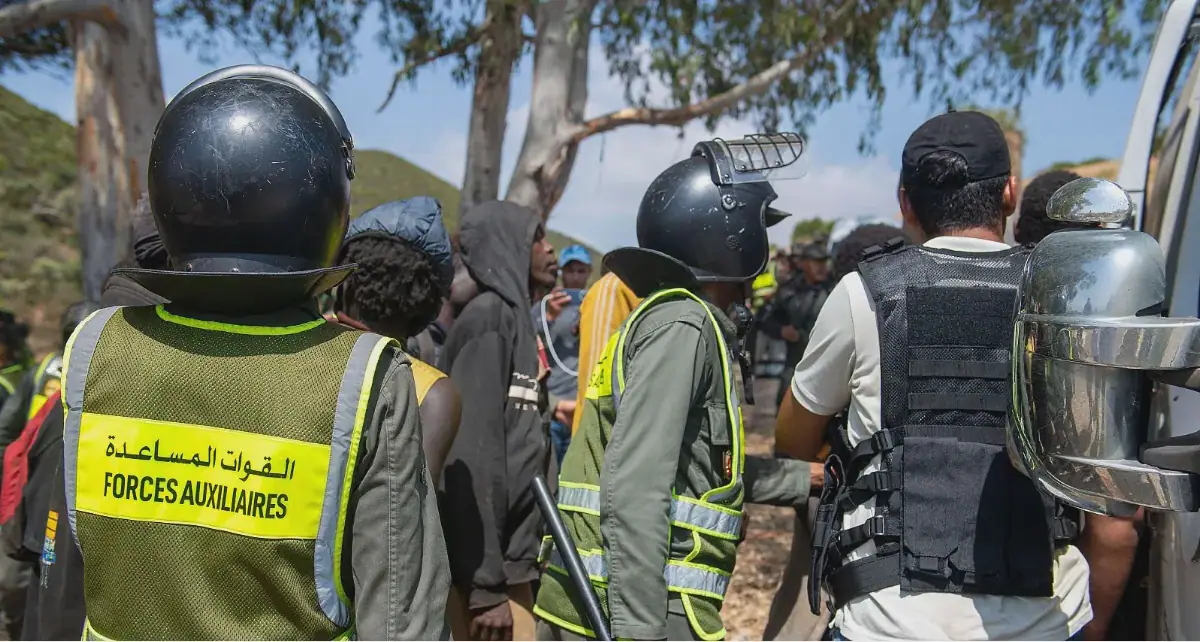
A Spanish report by the National Center for Immigration and Borders has disclosed new information about the events at Ceuta on July 30-31. The report highlights the role of Moroccan security forces in directing crowds towards the Spanish border, describing it as a tactical move that exceeded the capabilities of known migrant smuggling networks in the region. The report notes that Moroccan security forces engaged in "active guidance of crowds towards crossing points."
The report points to prior planning and tactical specialization in managing the movements, with limited presence of Moroccan security forces at some sites. This was accompanied by directing crowds towards border crossings and facilitating their flow at two levels: entry into Spanish territory and exit from it. These findings support previous reports by the Spanish news agency EFE regarding instructions issued by high-ranking Moroccan officials at the Ceuta border.
According to the General Directorate of Investigations of the Spanish National Police, the two high-ranking Moroccan security officials involved were Wali of Tangier Mohamed Al-Walidi and General Supervisor of Security in the Strait and Fnideq Abdel Fattah Al-Sayed Al-Radi. They were seen in video recordings giving instructions near the Bab Ceuta border crossing in the Fnideq area.
Spanish investigators collected 73 video recordings of the events and analyzed five of them in-depth. These recordings indicate that the role of Moroccan authorities shifted from mere border monitoring to actively directing migrants, rather than preventing mass flows and protecting citizens from crossing risks. This represents a significant development in understanding the events at Ceuta.
The report also highlights the digital aspect of the events, with the manipulation of circulating messages and the activation of social media accounts to disseminate misinformation. The report describes this as "strategic guidance" of the movements, alongside facilitating large-scale access routes and controlling movement towards specific sites at planned times.
These findings raise questions about the nature of the goals behind the Ceuta events, particularly given indications that they went beyond mere human gatherings and random migrant crossings. The Spanish judiciary is continuing its investigations, with the National Court deciding to hear four protected witnesses to clarify the movements and parties involved.
The ongoing investigations aim to uncover the sequence of orders and determine responsibilities within Moroccan security agencies. This case has reopened the file on the use of migration in political conflicts between Rabat and Madrid, with allegations that the Moroccan regime used the migration card to pressure and negotiate with Spain.
Key points
- Moroccan security forces actively directed migrant crowds towards Spanish territory at Ceuta.
- The involvement of high-ranking Moroccan officials in directing migrant flows has been confirmed.
- The Spanish judiciary is investigating the use of migration as a tool in political conflicts between Morocco and Spain.
Reporting sources
- هل وجّه المخزن تدفق المهاجرين نحو سبتة؟.. هذا ما كشفه تقرير إسباني جديد · Echorouk El Yawmi