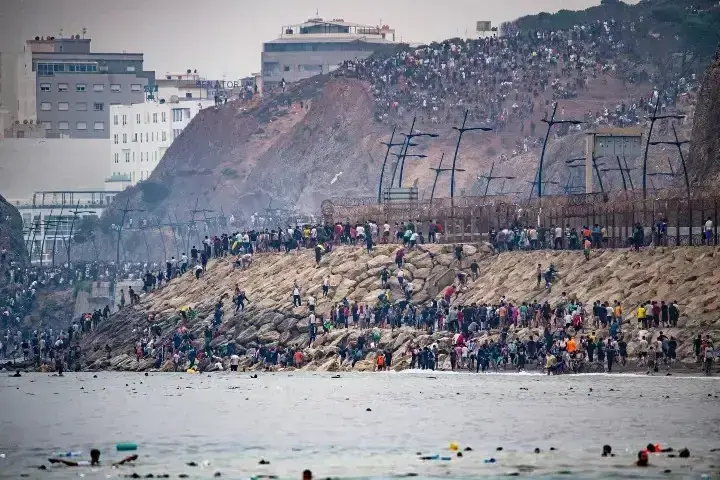
A report by the Spanish National Center for Migration and Borders (CENIF) has revealed that 18 Moroccan officials were involved in the mass entry of migrants into the Spanish city of Ceuta on July 30-31. The report, which was submitted to Judge Maria Tardon of the Spanish National Court, was based on the testimonies of 81 migrants and analysis of images documenting the events. The officials implicated include security and civilian officials from various administrative levels, including the Wali of Tangier-Tetouan-Al Hoceima region, Younes Tazi.
The CENIF report concluded that the mass entry of migrants into Ceuta was not a spontaneous incident, but a planned and organized operation by Moroccan authorities. The report noted that the officials implicated played leadership and coordination roles during the border crossing, which resulted in the deaths of 83 migrants. The report also identified several high-ranking Moroccan security officials, including the Wali of Tetouan, Mohamed Walidi, and the head of security in the Tangier-Mediterranean-Fnideq region, Abdel Fattah Sid Radi.
The Spanish General Directorate for Investigations had previously submitted a report to Judge Tardon, identifying two high-ranking Moroccan security officials who allegedly issued instructions to migrants during their entry into Ceuta. The two officials, Walidi and Sid Radi, were reportedly involved in guiding the migrants during the crossing. The reports were compiled based on witness statements, images, and social media posts.
The investigation into the mass entry of migrants into Ceuta has revealed a complex web of involvement by Moroccan officials. The CENIF report analyzed 13 hearing transcripts and matched witness statements with images and police databases. The investigation also examined social media posts and media reports to piece together the events surrounding the migrant crossing.
The incident has strained relations between Spain and Morocco, with Spain's government seeking to hold Moroccan officials accountable for their alleged roles in the migrant crossing. The Spanish authorities have been working to identify and prosecute those responsible for the incident, which resulted in significant loss of life and highlighted the challenges of managing migration flows in the region.
The reports have sparked controversy in Morocco, with some questioning the extent of the involvement of Moroccan officials in the migrant crossing. The incident has also raised concerns about the treatment of migrants and the need for greater cooperation between European and African countries to address the root causes of migration.
The investigation into the Ceuta migrant crossing is ongoing, with Spanish authorities working to gather more evidence and testimony from witnesses. The case has significant implications for migration policy and relations between Spain and Morocco, and is likely to continue to be a contentious issue in the region.
Key points
- The Spanish report implicates 18 Moroccan officials in the mass entry of migrants into Ceuta on July 30-31.
- The officials implicated include high-ranking security and civilian officials from various administrative levels.
- The incident has strained relations between Spain and Morocco, with Spain seeking to hold Moroccan officials accountable for their alleged roles in the migrant crossing.
Reporting sources
- تقرير إسباني: تورط 18 مسؤولا مغربيا في تدفق المهاجرين نحو سبتة · ennaharonline.com