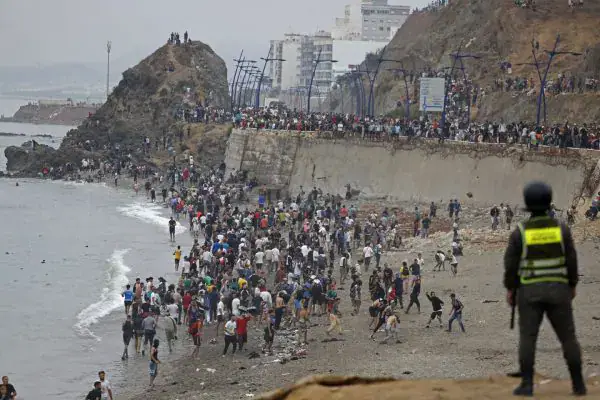
Spanish investigators have identified 97 connections between the coordinators of the July 30 mass migration to Ceuta and several Moroccan security bodies, including the Royal Gendarmerie and Moroccan intelligence services. This was achieved through analysis of 19 WhatsApp groups and cross-referencing data from cyberattacks. The investigation, led by the Centro Nacional de Inteligencia y Fronteras (CNIF) of the Spanish National Police, has shed new light on the events surrounding the mass migration.
The CNIF analyzed 19 WhatsApp groups with a total of 1,141 Moroccan users, categorizing them based on their level of involvement and operational role in preparing and coordinating the migration. The investigators focused on the address books of identified key users, including 19 administrators and 32 "animators" responsible for stimulating exchanges and disseminating instructions. This work revealed 97 connections with phone numbers belonging to members of Moroccan security and intelligence services.
To authenticate the identity and professional affiliation of the owners of these phone lines, the Spanish police conducted open-source checks. They cross-referenced the data with that leaked by the hacktivist group Jabaroot, which has claimed cyberattacks against Moroccan official institutions. This cross-checking yielded results in nearly half of the cases, with the police obtaining "probable identity information" in 49 instances.
The investigation highlights the diversity of entities whose profiles were identified, including the General Directorate of National Security (DGSN), intelligence services, Royal Gendarmerie units, and personnel operating in coordination rooms and road traffic units in Morocco. The connections detected do not appear to be limited to a specific police force or administrative level, but rather cover a wide range of Moroccan security and intelligence apparatus.
The report also reveals a geographic correlation between the location of detected profiles and declared migration routes. The CNIF notes a "correspondence between the localization of detected profiles and declared itineraries," which could indicate a deliberate strategy to manipulate migrants. Furthermore, the investigation uncovered a technique used to mask direct contacts, involving "liaison profiles" that act as intermediaries to avoid tracing.
The judicial investigation is ongoing under the authority of Judge María Tardón. The former delegate of the government in Ceuta is set to testify on December 1, while the Spanish consul in Tétouan and the former chief of staff of the government delegate at the time of the events have been summoned as witnesses to shed light on the manipulation orchestrated by the Moroccan makhzen.
The mass migration to Ceuta on July 30 involved around 70,000 people, mostly young Moroccans. The incident has strained relations between Spain and Morocco, with the Spanish government accusing Moroccan authorities of instrumentalizing migrants for geopolitical purposes. The investigation's findings have significant implications for the migrants themselves, who were often driven by socio-economic desperation and became pawns in a larger geopolitical game.
Key points
- The investigation found 97 connections between Moroccan security services and the coordinators of the mass migration to Ceuta.
- The CNIF analyzed 19 WhatsApp groups with 1,141 Moroccan users to identify key players and their roles in the migration.
- The investigation revealed a wide range of Moroccan security and intelligence entities involved in the coordination of the mass migration.
Reporting sources
- Enquête sur l’entrée massive à Ceuta: L’implication des services marocains confirmée · Le Jeune Indépendant