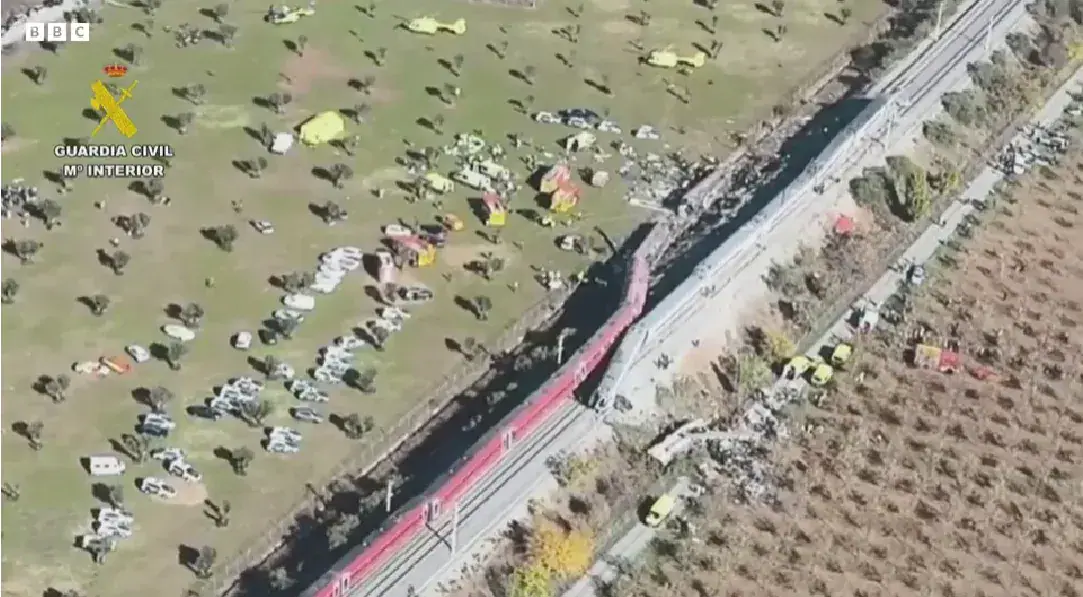
Spain has started three days of mourning following a devastating train crash that resulted in the deaths of at least 68 people and injured numerous others. The disaster occurred when a train traveling from Madrid to Seville collided with a stationary train on Wednesday morning. Emergency responders worked through the night to rescue victims and recover bodies, with many of those killed still to be identified.
The crash, one of Europe's worst rail disasters in modern history, is under investigation. According to officials, the stationary train, operated by Iryo, had 147 passengers on board and had stopped due to a computer failure. Spain's transport minister, Óscar Puente, stated that a 24-hour control center in Madrid took over during the system failure but made an "inexplicable" decision to instruct trains to move again without speed restrictions.
Audio recordings between train controllers and drivers suggest that one high-speed train was given clearance to move despite another train ahead having stalled. The force of the crash caused several carriages to fall down an embankment, with witnesses describing scenes of chaos, including people crying and bleeding, and smoke billowing throughout the carriages. One carriage caught fire during the incident.
Prime Minister Pedro Sánchez described the incident as a national tragedy, stating that "the whole of Spain is grieving" and that "lives have been shattered, families have been torn apart, the pain is immense." He also expressed concern that Spain had suffered two serious rail disasters this year, following a high-speed crash near Córdoba in January that killed 46 people.
Hundreds of personnel have been deployed to the disaster site to assist with recovery efforts, including drones and helicopters to locate victims and remove rubble. The incident has prompted a response from across the country, with most political parties suspending campaigning for upcoming elections out of respect for the victims.
The leader of the far-right party Vox, Santiago Abascal, stated that his party would not suspend campaigning, describing attempts to use the mourning period to silence criticism of the country's rail infrastructure as "unacceptable." The incident has raised questions about the safety and reliability of Spain's rail network.
The train that struck the stationary train was operated by Renfe, Spain's state-owned railway company, and carried 397 passengers. Iryo, the operator of the stationary train, stated that its train was "struck from behind" by the Renfe train. The investigation into the cause of the disaster is ongoing.
Key points
- At least 68 people were killed in the train crash.
- The disaster is one of Europe's worst rail disasters in modern history.
- Spain has begun three days of national mourning following the incident.