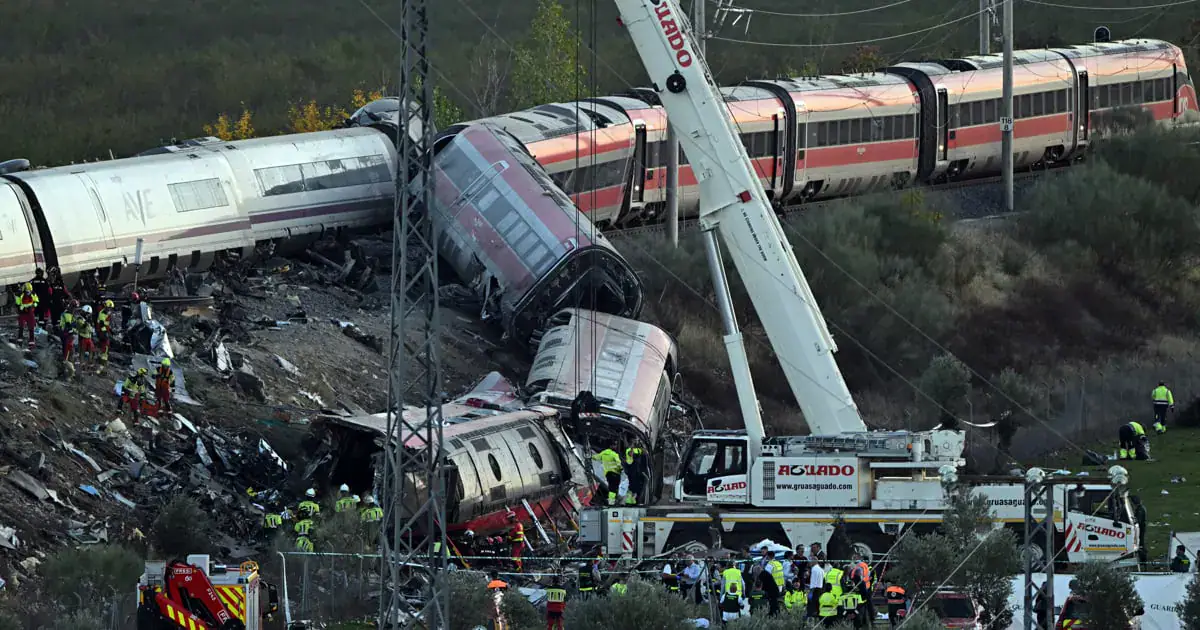
Spain has begun three days of mourning after a devastating high-speed train crash killed 68 people and injured scores. The collision occurred on Wednesday morning in the central region of Castilla-La Mancha when a Renfe train ploughed into the back of a stationary Iryo train. The crash has raised concerns about safety on Spain's rail network, with the transport minister citing an "error" and "inexplicable circumstances" that led to the tragedy.
The train crash is one of Europe's deadliest rail disasters this century. Emergency services worked through the night to find further victims on the key line linking Madrid with the southern city of Seville. A school in the nearby village of Urda has been set up to allow relatives to enquire about their loved ones. Red Cross workers are providing support to those affected, with psychologist Carmen Garcia warning that "long and hard hours" are ahead for those grieving.
Survivor Pablo Mejia, 42, told AFP that a last-minute change of seat saved his life. He described the moment of impact as "a very strong hit... a lot of people on the floor, on top of each other, seats ripped out, suitcases, a lot of chaos". Another survivor, Josimar Medina, a 31-year-old Peruvian, said he was sleeping on the Renfe train when "I woke up and I was in the air".
The Civil Guard has set up offices in several cities to enable relatives of the victims to provide DNA samples and help identify the missing. Blood donation points have also been set up in Castilla-La Mancha and Madrid. Local priest Jose Miguel Fernandez joined the emergency services in offering support to the victims' families, saying "what matters most is being with the victims' relatives, that they feel the closeness".
Transport Minister Oscar Puente said an automatic control system went down on 69 kilometres of track, causing all trains to be stopped. However, the control centre decided to "resume traffic in circumstances that, from our point of view, are inexplicable". The Renfe train was travelling at 25 kilometres before striking the Iryo train. Puente added that the control centre "had more than enough time to verify the error, and they did not fix it".
This is not the first high-speed rail collision in Spain this year. In January, two trains collided in the southern region of Andalusia, killing 46 people. The investigation into that accident is ongoing. The latest disaster comes ahead of an early general election on November 29, with Socialist Prime Minister Pedro Sanchez seeking to overturn unfavourable polls.
The Spanish government has faced criticism over its management of the country's railways. The opposition has called for an investigation into the cause of the crash and the government's handling of the rail network. The three days of mourning will allow the country to come together to grieve and pay respects to the victims of the tragedy.
Key points
- 68 people killed in high-speed train crash in Spain
- Spain begins 3 days of mourning for victims of train crash
- Investigation into cause of crash and government's handling of rail network underway