The Mauritanian Navy recently rescued 134 migrants attempting to reach the Canary Islands, highlighting the country's commitment to preventing irregular departures and saving lives at sea. The migrants, consisting of 118 men, 14 women, and two children of various nationalities, were intercepted off the coast of Nouadhibou. This operation demonstrates Mauritania's efforts to combat migrant trafficking networks and prevent its territory from being used as a transit point to Europe.
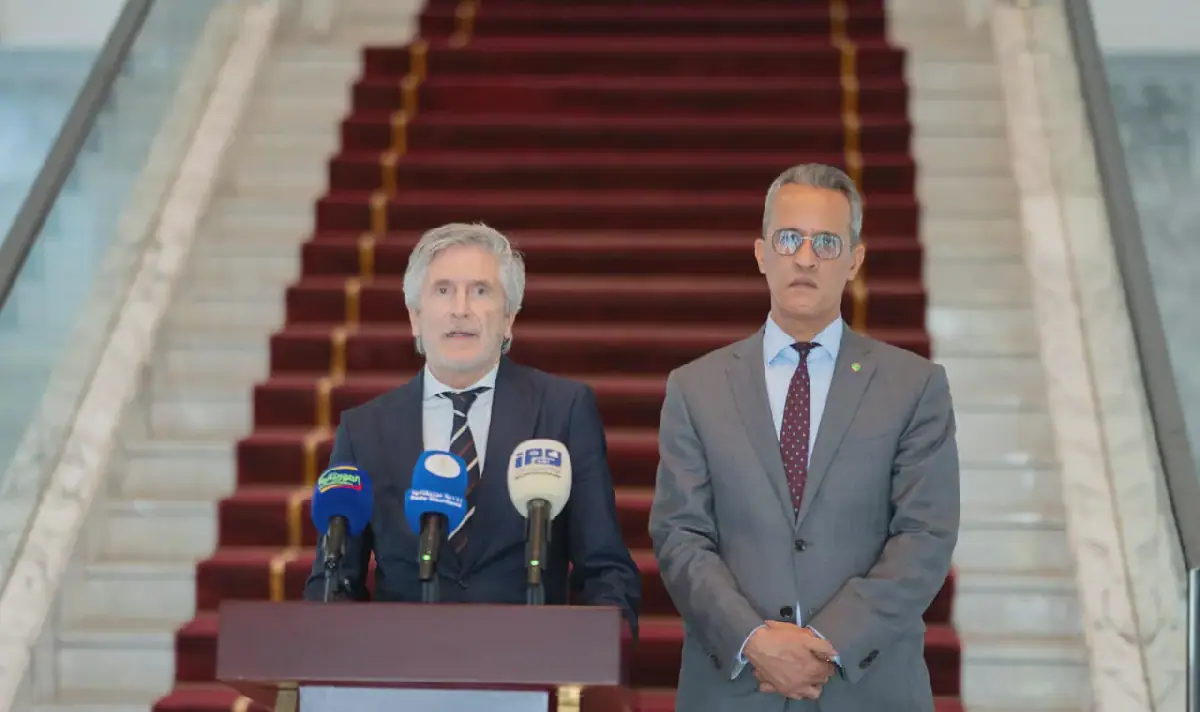
The rescue operation took place amid a surge in arrivals to the Canary Islands, with over 4,000 people recorded in October, according to provisional figures from the Canary Islands autonomous community. Spanish Interior Minister Fernando Grande-Marlaska Gómez visited Nouakchott, where he met with Mauritanian officials and President Mohamed Ould Cheikh El Ghazouani. During his meetings, Grande-Marlaska praised the level of cooperation and coordination between Spain and Mauritania in combating irregular migration and transborder crime.
Grande-Marlaska described Mauritania as a "strategic partner and ally" of Spain, acknowledging the efforts made by Mauritanian authorities and the results achieved through their collaboration. This recognition is significant, given the evolution of Atlantic migration routes. With increased controls off the coast of Morocco, Mauritania, and Senegal, departures have shifted southward, primarily from Gambia, increasing the duration and risks of the journey to the Canary Islands.
Mauritanian authorities advocate for a comprehensive approach to combating irregular migration, incorporating security, legal, humanitarian, and developmental aspects. This strategy aims to dismantle migrant trafficking networks, strengthen border surveillance, and prevent the country's territory from being used as a transit point to Europe. Mauritanian Interior Minister Mokhtar Ould Ahmed Bousseif emphasized the need for permanent coordination with regional and international partners.
The recent rescue operation in Nouadhibou illustrates this dual approach, preventing irregular departures while preserving human lives exposed to the dangers of the crossing. Spain and Mauritania are seeking to expand their cooperation beyond migration issues, with Grande-Marlaska advocating for the activation and diversification of partnership areas, including economic and social dimensions. This orientation was also discussed during his meeting with President Mohamed Ould Cheikh El Ghazouani.
The two countries aim to strengthen their bilateral relationship and explore opportunities for cooperation within the framework of Mauritania's partnership with the European Union. Grande-Marlaska expressed his gratitude to President El Ghazouani for Mauritania's condolences following a tragic train accident in Adamuz. He reaffirmed Spain's support for strengthening the partnership signed between Nouakchott and Brussels in 2024.
For Mauritania, the challenge is now to convert Spain's recognition of its strategic role into concrete benefits, including financing for development projects, institutional capacity building, expertise transfer, vocational training, maritime cooperation, and job creation for young people.
Key points
- Mauritania plays a strategic role in securing the Atlantic migration route to the Canary Islands.
- Spain has praised Mauritania's efforts to combat irregular migration and transborder crime.
- The two countries are seeking to expand their cooperation beyond migration issues.