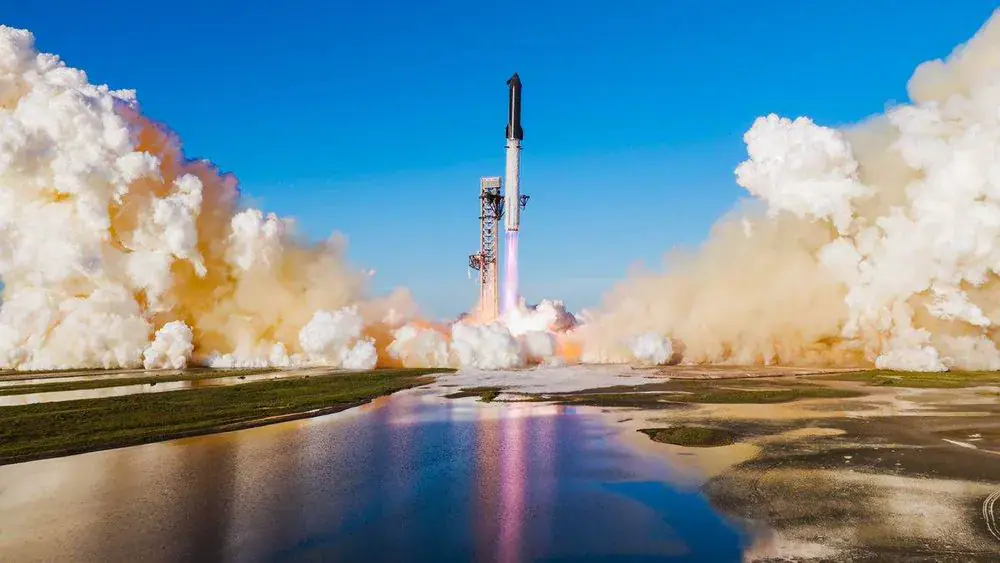
SpaceX's Starship spacecraft was reported "healthy" as it orbited the Earth and was on track to return to its Texas launch site on Saturday. The spacecraft was part of the 15th test flight of the world's biggest and most powerful rocket system. The mission aimed to demonstrate the feasibility of fully reusable rocket systems, which can significantly reduce mission costs and enable frequent launches. The Starship spacecraft was expected to orbit the Earth 14 times before returning to Earth.
The test flight was initially planned to feature a groundbreaking twin capture of both the Super Heavy booster and the Starship. However, the Super Heavy booster aborted its capture due to a guidance, navigation, and control issue detected near the end of its descent. The booster diverted to the Gulf of Mexico, where it automatically self-destructed before hitting the water. This setback occurred despite SpaceX having successfully recovered the Super Heavy booster three times previously.
The Starship spacecraft, which gives the rocket system its name, was orbiting the Earth and was expected to continue doing so before returning on Saturday. SpaceX reported that the Starship and its heat shield were healthy, with no issues tracked. The spacecraft launched 26 satellites to join others in Elon Musk's Starlink satellite internet constellation. The mission was considered a "mixed bag" by aerospace expert Clayton Swope, as the failure to catch the Super Heavy was offset by the Starship's successful orbit.
The Starship spacecraft has various applications, including launching internet satellites and data centers into orbit, as well as ferrying people to the Moon and Mars. The US space agency NASA is counting on Starship to serve as a lunar lander on its Artemis mission. NASA administrator Jared Isaacman congratulated SpaceX on the launch, without mentioning the booster disappointment. SpaceX plans to return Starship to Earth after more than 22 hours of flight and recover it at around 3:20 pm on Saturday.
The "catch" of the Starship is an extraordinarily complex process, as the spaceship will be falling much faster and from a much higher altitude than the booster. The Starship is meant to carry out a controlled descent and nestle between two mechanical "chopstick arms" at the launch site. SpaceX commentator Kate Tice stated that the company would only attempt the catch if the ship passed all system checks and decision gates along the way.
Due to the risks of losing control of Starship, SpaceX has planned for various scenarios where it will shorten the test flight and plunge the spaceship into the Pacific Ocean if necessary. Elon Musk, the world's richest person, has already revolutionized the space sector with partially reusable Falcon rockets. However, the Starship project has faced years-long delays as SpaceX grapples with novel engineering challenges, including transferring fuel to the spaceship while in orbit.
SpaceX is investing heavily in production and launch capabilities, with the capability to produce a spaceship every two weeks and a booster every four weeks. During a tour of its million-square-foot factory at Starbase, SpaceX officials demonstrated the company's enhanced production capacity. The company plans to continue testing and refining its Starship technology to achieve its goal of fully reusable rocket systems.
Key points
- SpaceX's Starship spacecraft orbits Earth, set to return to Texas launch site after 15th test flight.
- Super Heavy booster aborted capture due to guidance, navigation, and control issue.
- Starship has various applications, including launching internet satellites and data centers into orbit, as well as ferrying people to the Moon and Mars.
Reporting sources
- SpaceX’s Starship set for return to Earth after booster catch aborted · African News Agency