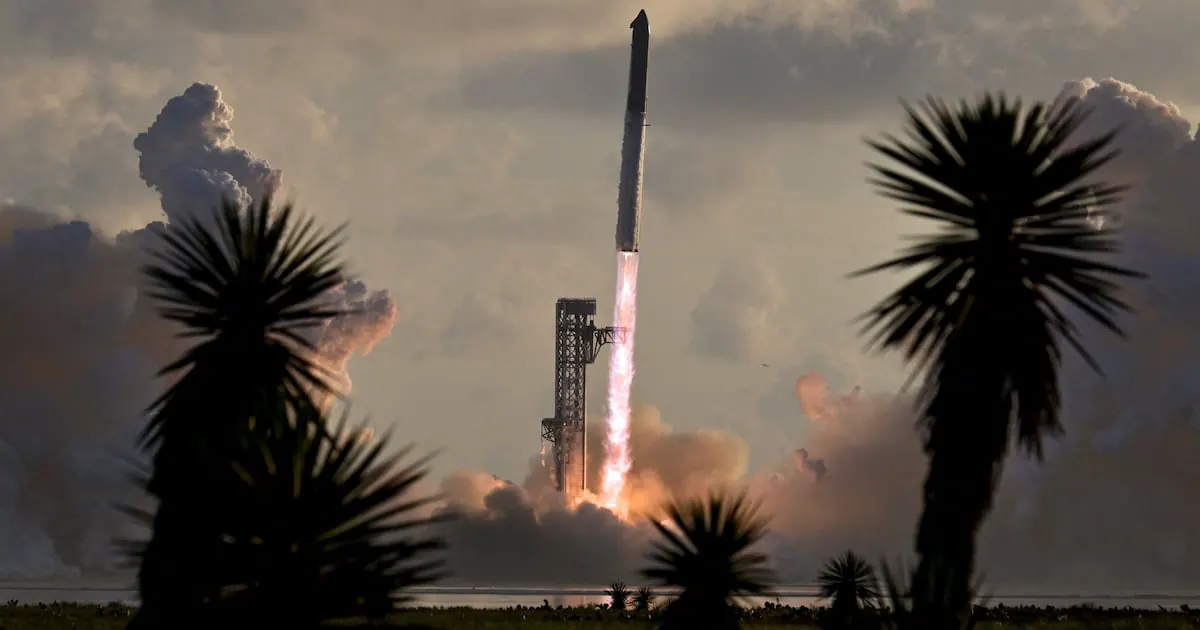
SpaceX's Starship rocket successfully reached orbit for the first time on Monday, marking a significant milestone for the company. The uncrewed, 40-storey-tall vehicle, comprising a Super Heavy booster rocket and the main upper-stage Starship vessel, launched from SpaceX's Starbase complex along the Gulf of Mexico near Brownsville. The Super Heavy booster lofted the Starship upper stage into space before returning to the Gulf of Mexico for an engine-controlled splashdown.
The mission encountered an issue when one of Starship's three main engines shut down earlier than planned, leading SpaceX spokesperson Dan Huot to announce that the craft would be unable to reach orbit. However, after an update from engineers, Huot reversed course, and Starship successfully reached orbit. Once in orbit, Starship began deploying 26 next-generation Starlink satellites one by one at a planned altitude of roughly 269km.
This historic flight marks the 14th test flight of Starship, but it's the first to carry a real payload. The new Starlink internet satellites are potentially worth millions of dollars and are a crucial part of SpaceX's profit nucleus. Analysts estimate that the launch of SpaceX's new V3 Starlink satellites equals hundreds of millions of dollars in projected revenue for the company's Starlink unit.
The V3 Starlink satellites can handle 10 times more data than their predecessor V2 mini-sats, which SpaceX has been launching 20 or 30 at a time on its workhorse Falcon 9 rockets. Elon Musk wants to launch the higher-capacity V3s in batches of 60 per launch once Starship goes into routine operation, a goal he aims to reach late this year.
Starship is also set to play a pivotal role in NASA's Artemis program, which aims to return astronauts to the moon's surface for the first time since 1972 and build a long-term lunar presence as a stepping stone to eventual human exploration of Mars. The success of Starship is crucial to SpaceX's corporate future, with investors wiping about $100bn off SpaceX's market value after a previous test flight was aborted.
The development of Starship has been a long and costly process, with nearly a decade of development costing SpaceX more than $15bn to date. Despite this, Musk has said he envisions ultimately flying hundreds or thousands of Starships a year, a launch pace unprecedented in the space industry.
One critical objective for Starship's return flight to Earth will be surviving its deorbital firing and precisely angling the vehicle for atmospheric re-entry. The spacecraft's final controlled descent is designed to culminate with a thruster manoeuvre to flip the vehicle vertically so that it hits the sea in a nose-up position. No recovery of the spacecraft is planned for this latest flight.
Key points
- Starship reached orbit for the first time, deploying 26 new Starlink satellites despite an engine issue.
- The success of Starship is crucial to SpaceX's corporate future and its role in NASA's Artemis program.
- SpaceX aims to launch the higher-capacity V3 Starlink satellites in batches of 60 per launch once Starship goes into routine operation.