The Mozambique Channel is gaining strategic importance due to rising international interest and insurgent activity at sea. Lieutenant General John Brennan, Deputy Commander of United States Africa Command, recently visited Mozambique and Madagascar, highlighting the growing maritime capabilities of Islamic State Mozambique and the security of Cabo Delgado's multibillion-dollar liquefied natural gas investments. The US and Madagascar have signed an Acquisition and Cross-Servicing Agreement to facilitate logistical cooperation in maritime patrols and military exercises.
The agreement comes amid US concerns about Madagascar's deepening military ties with Russia. These developments coincide with disruptions to Middle Eastern energy exports caused by the US-Iran war, reinforcing the strategic significance of Southern Africa's offshore energy projects. The US is encouraging Mozambique to join regional maritime information-sharing arrangements and is proposing expanded military exercises and bilateral training. This signals a greater emphasis on operational cooperation in the region.
The maritime dimension of the Cabo Delgado insurgency has intensified this year, with 34 potentially maritime-related events involving Islamic State Mozambique reported by mid-November. These include vessel seizures, abductions of fishers and sailors, extortion of coastal communities, and clashes with naval forces. Several incidents demonstrate the insurgents' ability to operate in coastal waters and target larger vessels. This expanding maritime activity poses rising security risks to commercial vessels operating in or transiting northern Mozambican waters.
The growing concentration of offshore energy infrastructure in the region warrants careful consideration. Italian energy company Eni began drilling for its second floating LNG project, Coral North, in November, and expects to reach a final investment decision on a third floating LNG facility by 2027. TotalEnergies resumed onshore and offshore construction of its $20 billion Mozambique LNG project in January, and Mozambique's government has approved the revised development plan for the $26 billion ExxonMobil-led Rovuma LNG project.
Locating floating production facilities roughly 50 km offshore may afford some protection from the insurgency, but distance alone no longer guarantees security. Persistent maritime criminality, including drug trafficking networks operating between Mozambique and the Makran coast of Iran and Pakistan, adds to the risks. Threats to commercial operations would have disproportionate consequences for investor confidence and continued operations. The March 2021 Palma attack prompted the TotalEnergies-led Mozambique LNG consortium to declare force majeure, which was lifted only in 2025.
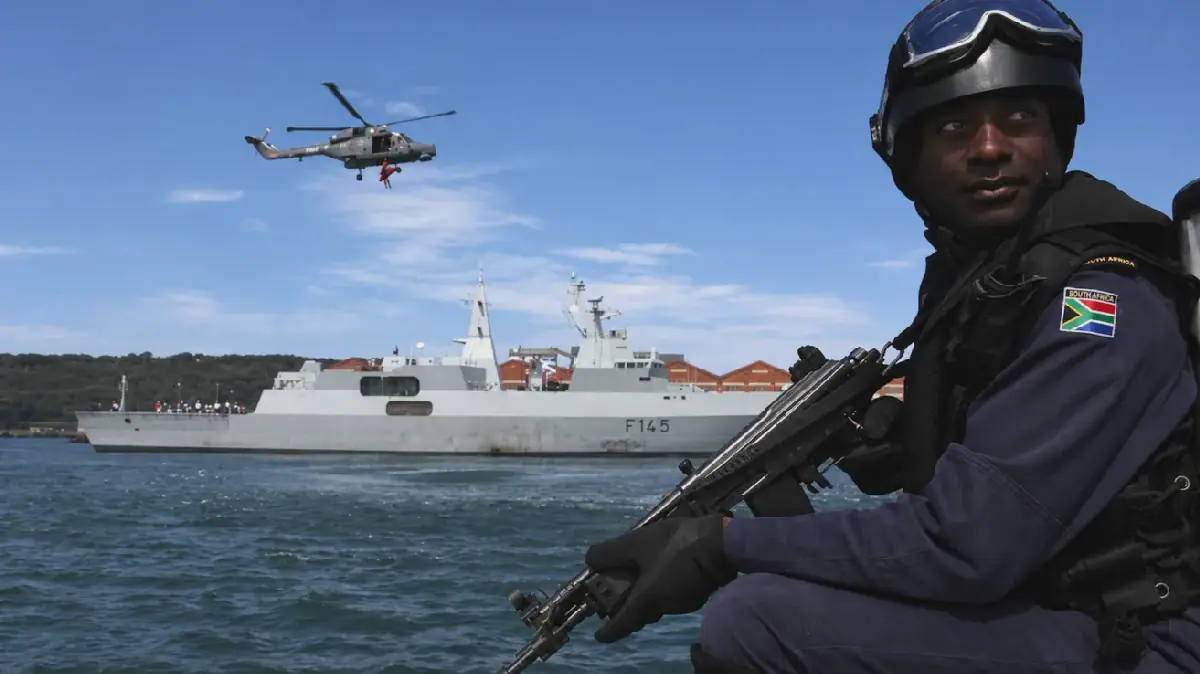
The US and other international partners are tackling maritime security challenges in the same area where South Africa established counter-piracy patrols under Operation Copper in 2011. However, no long-range maritime patrols have been conducted under Operation Copper for four consecutive financial years due to the unavailability of South African naval vessels. Southern Africa increasingly faces the problem of coordinating several overlapping mechanisms, making a public review of Operation Copper essential.
States that cannot implement their maritime security commitments risk having their priorities set by those that can. The increasingly complex threat environment, expanding commercial interests, and growing involvement of international security actors should prompt a public review of Operation Copper and its contribution to implementing the Integrated Maritime Security Strategy. The review will help to address the challenges and ensure the security of the Mozambique Channel.
Key points
- The Mozambique Channel's growing strategic importance requires regional states to reassess their maritime commitments and capabilities.
- The maritime dimension of the Cabo Delgado insurgency has intensified, posing rising security risks to commercial vessels.
- A public review of Operation Copper is essential to address the challenges and ensure the security of the Mozambique Channel.