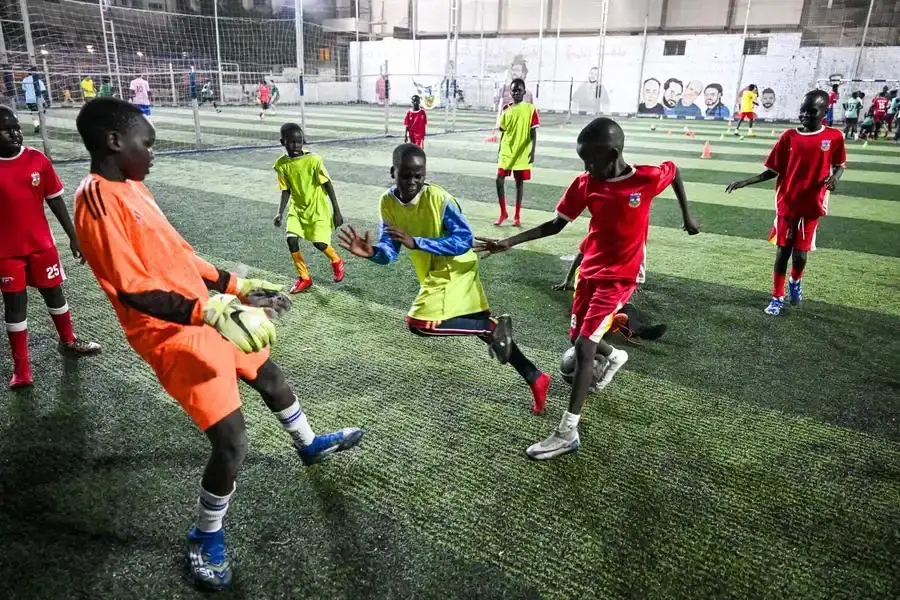
In eastern Cairo, a group of young refugees from South Sudan have found a sense of belonging and hope at the Future Sports Academy. The academy, established on June 6, 2020, offers a free and safe environment for children to play football, socialize, and momentarily forget the hardships of displacement. For 13-year-old William Sholi, who arrived in Egypt three years ago, the academy has been a haven where he can play on a real pitch, unlike back home where he used to play in the streets.
The academy was set up amid the COVID-19 pandemic when schools and public spaces were closed. Initially, it brought together around 60 to 70 children from the neighborhood, and today it runs a regular program open to children of all backgrounds, with most participants being South Sudanese. The academy serves children in a country that hosts more than 1.08 million registered refugees and asylum-seekers from dozens of nationalities. Co-founder and head coach Boulos Lam, who fled conflict in South Sudan over a decade ago, believes sports can help displaced children recover psychologically and integrate into their new communities.
Lam says that when conflict erupts, education is disrupted, and children lose their sense of stability. The academy was started to give South Sudanese children, alongside any Egyptian or other children who wish to join, a healthy environment to play, heal, and belong. The academy currently trains 62 boys and girls aged between 5 and 16 three times a week, with five volunteer coaches, four from South Sudan and one from northern Sudan. Despite having no sponsors or financial support, the academy continues to operate, with each family contributing 25 Egyptian pounds (0.50 U.S. dollars) per player to cover the cost of renting the pitch.
For 15-year-old John Garang, who moved to Cairo from South Sudan at the age of 10, joining the academy has helped him discover a passion for football. A seventh-grade student who admires Barcelona and Egyptian football star Mohamed Salah, Garang said he had little experience when he first joined. With the help of the coaches, he has improved his skills and found a sense of belonging among his teammates.
The academy's impact extends beyond the football pitch, providing a sense of community and support for the children. The coaches, who volunteer their time without pay, play a crucial role in helping the children heal and integrate into their new communities. Lam, for example, works for a local office furniture company to support his family while dedicating his time to the academy.
Despite limited resources, the academy continues to thrive, with equipment being scarce and sometimes five players having to share one ball during drills. However, the children's enthusiasm and dedication to the sport have helped them overcome these challenges. For Sholi, the academy has given him a chance to pursue his dreams of playing football professionally, and he hopes one day to play in Europe, inspired by his idol Cristiano Ronaldo.
As the academy looks to the future, it remains committed to providing a safe and supportive environment for South Sudanese refugee children to play, heal, and build friendships. With the help of its volunteer coaches and supporters, the academy continues to make a positive impact on the lives of these children, offering them a chance to rebuild their lives and pursue their passions.
Key points
- The Future Sports Academy provides a free and safe environment for South Sudanese refugee children to play football and socialize.
- The academy has helped children recover psychologically and integrate into their new communities through sports.
- Despite limited resources, the academy continues to operate and make a positive impact on the lives of the children.