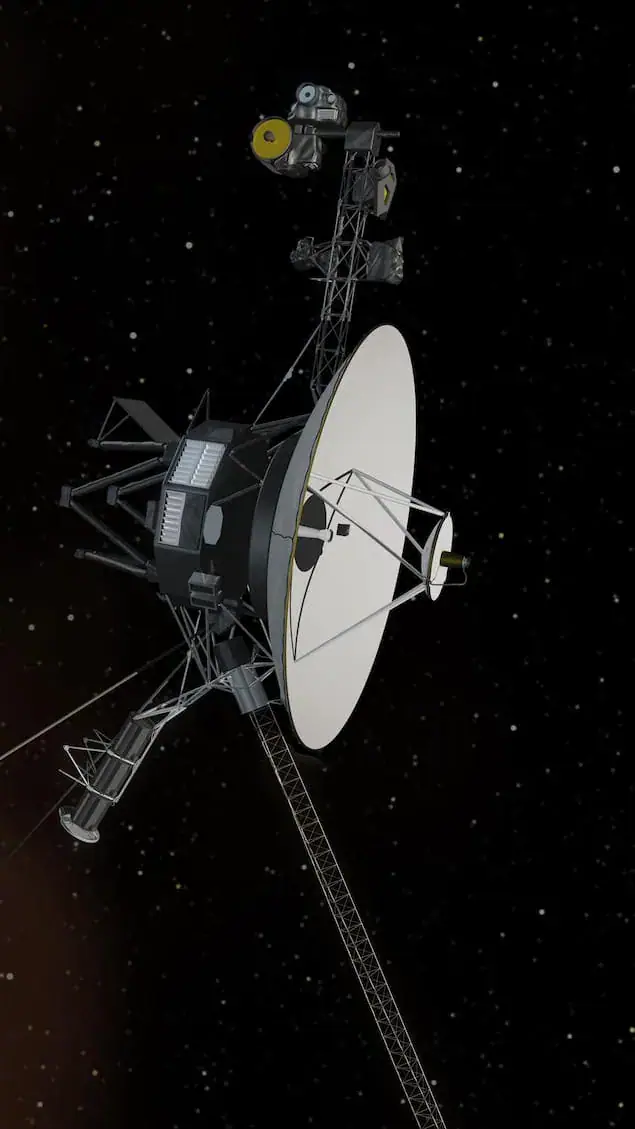
The US space agency NASA announced on Thursday that its Voyager 1 spacecraft has reached a distance of 25.9 billion kilometers from Earth, marking a new historical milestone. This achievement comes nearly 49 years after the spacecraft was launched on September 5, 1977. Voyager 1 is now the first human-made object to reach a distance of one light-day from Earth. A light-day is the distance light travels in 24 hours, approximately 300,000 kilometers per second.
Voyager 1 was launched to study the external planets of the solar system, along with its twin spacecraft, Voyager 2, which was launched on August 20, 1977. The spacecraft flew by Jupiter in 1979 and Saturn in 1980, providing unprecedented observations of these planets and their moons. In August 2012, Voyager 1 became the first spacecraft to cross the heliopause, the boundary of the heliosphere, and entered the interstellar medium.
The spacecraft is now traveling at a speed of approximately 61,000 kilometers per hour and is the most distant human-made object from Earth. Voyager 1's trajectory is directed towards the region of the star Gliese 445, which it is expected to approach in about 40,000 years. The spacecraft carries a golden record, a copper disk containing sounds and images of Earth, which serves as a message to any potential extraterrestrial life form.
Despite being nearly 50 years old, Voyager 1 continues to operate, albeit with some limitations due to aging equipment and decreasing power supply. The spacecraft uses thermoelectric generators to convert the heat from plutonium decay into electricity. To extend its lifespan, NASA engineers have disabled some equipment and instruments to reduce energy consumption.
On November 14, NASA reported that it was no longer receiving scientific and technical data from Voyager 1. However, the spacecraft continues to transmit a carrier signal, allowing teams to monitor its status and confirm the milestone of reaching a distance of one light-day from Earth.
The achievement of Voyager 1 demonstrates the capabilities of space engineering and the longevity of a mission initially designed to explore the giant planets of the solar system. The spacecraft has revolutionized space exploration and continues to provide valuable insights into the outer reaches of the solar system and beyond.
As Voyager 1 continues on its journey, it will eventually reach the region of Gliese 445, providing a new frontier for space exploration. The spacecraft's legacy will serve as a testament to human ingenuity and the pursuit of understanding the vast expanse of space. With its historic milestone, Voyager 1 cements its place in the annals of space exploration.
Key points
- Voyager 1 reaches 25.9 billion kilometers from Earth, a new milestone after nearly 49 years in space.
Reporting sources
- NASA : Parcours de 25, 9 milliards de km de la sonde VOYAGER1, après 49 ans de voyage dans l’espace · Agence malienne de presse et de publicité