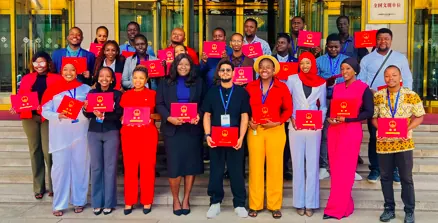
A group of South Sudanese journalists have returned home after participating in a training programme in China, where they learned new approaches to journalism, digital technology, and international media cooperation. The programme, organized by the China International Communications Group (CICG), brought together journalists from South Sudan and other African countries, including Tanzania, Rwanda, Zambia, The Gambia, and South Africa. The training covered modern journalism practices, investigative reporting, mobile journalism, and fact-checking.
The South Sudanese journalists who participated in the programme say they gained valuable experience and skills that they hope to apply back home. Chukude Emmanuel Mandela, a journalist with City Review, says one of his main lessons was understanding the role of journalism in national development. He believes that media can communicate development opportunities, inform the public, and contribute to a country's image, which is particularly important for South Sudan, where years of conflict have affected development and the country's international image.
Mandela was also impressed by the use of modern technology in journalism, particularly artificial intelligence and other digital tools. He believes that South Sudanese journalists should learn how to use emerging technologies responsibly, rather than simply viewing them as a threat. Mandela says that artificial intelligence and other digital tools can help journalists work more efficiently, access information, and reach wider audiences, while maintaining professional standards and editorial responsibility.
Another participant, Jennifer James, a journalist with The Dawn Newspaper, says the programme strengthened her skills in research, digital journalism, and multimedia storytelling. She believes that research is very important before producing a story, and that journalists need to verify information, identify reliable sources, and understand their subjects before publishing or broadcasting stories. James also observed significant differences between the Chinese and South Sudanese media environments, particularly in access to technology, infrastructure, and equipment.
James plans to share the knowledge she gained with other journalists, particularly young reporters who may not have opportunities to participate in international training. She also believes that balanced reporting can give international audiences a broader understanding of South Sudan, rather than presenting the country only through conflict and other challenges. James says that South Sudanese journalists, content creators, and other media professionals can contribute to telling the country's own story to international audiences.
The programme also allowed participants to interact with journalists from other African countries and build professional contacts that could support future cross-border reporting. Dieu Garang, a journalist with Hot in Juba Media, says the training strengthened his skills in fact-checking, storytelling, editing, research, and modern media technology. He believes that international exchanges can strengthen professional networks and cooperation between South Sudanese, African, and Chinese journalists.
The President of the Union of Journalists of South Sudan (UJOSS), Oyet Patrick Charles, says he is aware of South Sudanese journalists who have accessed different China-related training and exchange opportunities over the years. He recalls travelling to China in 2012 and following the experiences of journalists who have participated in similar programmes. Oyet hopes that continued cooperation between South Sudan and China will provide more opportunities for journalists to receive training in technology, journalism, and professional development.
Key points
- South Sudanese journalists learned new approaches to journalism and digital technology in a training programme in China.
- The programme aimed to strengthen professional networks and cooperation between South Sudanese, African, and Chinese journalists.
- Participants plan to apply the skills and knowledge they gained to improve journalism and media development in South Sudan.