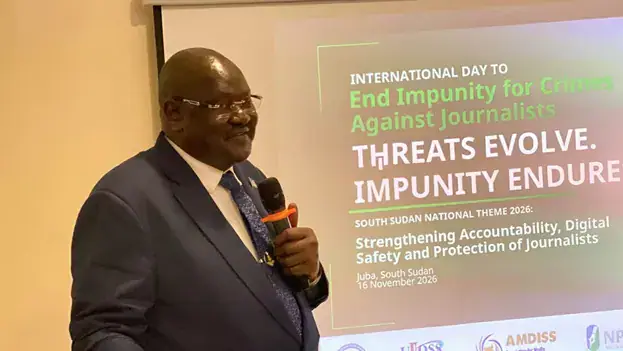
South Sudan's Caretaker Minister of Information, Communication, Technology, and Postal Service, Ateny Wek Ateny, has emphasized the need for stronger protections for journalists and accountability for crimes against media workers. He warned that ongoing intimidation, harassment, and digital threats pose significant risks to press freedom as the country approaches its upcoming elections. The minister made these remarks during the commemoration of the International Day to End Impunity for Crimes Against Journalists.
Ateny stated that crimes against journalists must be thoroughly investigated and that perpetrators should face justice, especially in light of the imminent electoral process. He highlighted the crucial role journalists play in promoting transparency, accountability, peacebuilding, and national development. The minister reaffirmed the government's commitment to freedom of expression and access to information as fundamental tenets of good governance.
The minister stressed the importance of implementing constitutional and legal protections for media professionals. He asserted that crimes against journalists must be properly investigated, and perpetrators held accountable in accordance with the law. Ateny underscored the necessity for journalists to report freely and safely during the elections, noting their vital role in educating voters, clarifying electoral procedures, and providing accurate information.
Ateny encouraged media practitioners to combat misinformation and hate speech, promote peaceful participation, and bolster public confidence in the electoral process. He also cautioned that advancements in technology, while offering new opportunities for journalism, have made media practitioners more vulnerable to online harassment, cyberbullying, and surveillance. The minister expressed particular concern about targeted online abuse faced by female journalists.
Ateny called for enhanced cybersecurity awareness, digital literacy, and practical safety measures to protect journalists. He stressed that protecting journalists necessitates collaboration among government institutions, law enforcement agencies, the judiciary, media regulators, journalists' associations, and development partners. The minister reaffirmed his ministry's commitment to fostering constructive dialogue and creating a supportive environment for safe, independent, and responsible journalism.
The minister commended the Union of Journalists of South Sudan (UJOSS) and its partners for organizing the commemoration, recognizing the contributions of UNESCO, UNMISS, and other partners in supporting media development and the safety of journalists. He urged stakeholders to translate the discussions from the event into actionable steps, particularly as the electoral period approaches.
Ateny also directed the Media Authority to immediately lift the suspension of the Media Development Institute (MDI) following a request from Ayaa Irene Lokang, Executive Director of the Association for Media Development in South Sudan (AMDISS). The institute had been suspended in 2024 due to disputes over its regulatory status and registration as an independent journalism training institution.
Key points
- The South Sudanese government is committed to freedom of expression and access to information as fundamental tenets of good governance.
- Journalists must be able to cover elections freely and safely, without intimidation or unlawful interference.
- Protecting journalists means protecting the public's right to information and strengthening accountability.