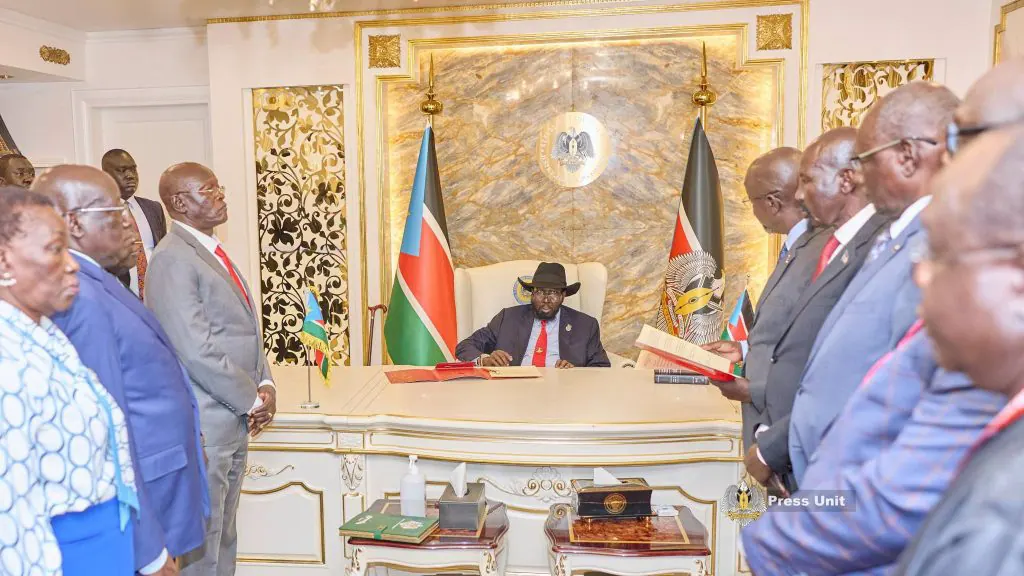
President Salva Kiir has signed sweeping amendments to South Sudan's electoral law, clearing a legislative hurdle ahead of the December 22 general elections. The amendments address key legal and institutional questions surrounding South Sudan's long-delayed political transition, including the tenure of the president and vice presidents, the composition of parliament, voting rights for citizens abroad, and the administration of elections.
Under the amended legislation, President Kiir will remain in office with full constitutional powers throughout the electoral period until an elected president assumes office. However, the first vice president and four other vice presidents are required to leave office three months before the elections. This provision has attracted scrutiny because South Sudan's transitional government was established under the 2018 peace agreement, which created the current arrangement of five vice presidents as part of a power-sharing framework intended to end years of civil conflict.
The legislation also provides for a National Legislative Assembly, with 270 members, including 50 percent of seats filled through elections in geographical constituencies, 35 percent through proportional representation from women's closed party lists, and 15 percent through other closed party lists. An additional 66 appointed members will represent veterans, organised forces, minorities, and people with special needs. The amended framework also provides for 580 lawmakers across South Sudan's 10 state legislatures, establishing the proposed composition of subnational legislative institutions ahead of the vote.
The signing ceremony was attended by Minister of Presidential Affairs Africano Mande Gedima, who said the amendments were intended to harmonise inconsistencies in the existing electoral legislation and bring it into alignment with the Transitional Constitution of South Sudan, 2011, as amended. The revised law also operationalises the principle of delinking elections from the permanent constitution-making process and the national census, allowing electoral preparations to proceed without waiting for the completion of those two transitional requirements.
Other provisions extend voting rights to eligible South Sudanese living abroad and introduce changes to electoral administration at state and administrative-area levels. The legislation was debated against a backdrop of disagreements over the size and cost of government institutions. Parliamentary Affairs Minister Michael Makuei Lueth argued that reducing the size of government was necessary, linking the expansion of public institutions to the country's employment challenges.
The National Elections Commission announced December 22 as the election date in June and has since been conducting preparations, including training state election committees on voter registration and other electoral procedures. The signing comes at a particularly consequential moment in South Sudan's transition, with the country approaching the three-month mark before the scheduled elections. Existing electoral provisions had required the dissolution of national and state legislatures and governments within three months of an election, making the question of continuity in office a central issue in the latest legislative changes.
The presidential assent removes a legislative hurdle, although the conduct of the elections will also depend on the completion of electoral preparations and the implementation of the amended legal framework. South Sudan has repeatedly postponed elections since gaining independence in 2011, with political disagreements, insecurity, and delays in implementing the 2018 peace agreement complicating successive electoral timetables. The December vote is intended to mark a transition from the current power-sharing arrangement to an elected government.
Key points
- President Salva Kiir has signed amendments to South Sudan's electoral law, clearing the way for general elections in December.
- The amendments address key questions surrounding South Sudan's political transition, including the tenure of the president and vice presidents, and the composition of parliament.
- The December elections are intended to mark a transition from the current power-sharing arrangement to an elected government.