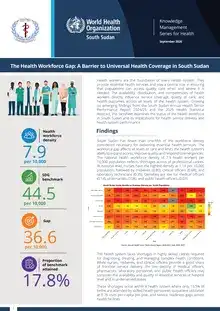
The health system in South Sudan is facing a significant workforce gap, which is hindering its ability to provide universal health coverage. According to the South Sudan Annual Health Sector Performance Report 2024/25 and the 2025 Health Statistical Abstract, the country's health workforce density is 7.9 health workers per 10,000 population, which is less than one-fifth of the required workforce density for delivering essential health services. This shortage affects all levels of care and limits the health system's ability to expand access, improve quality, and respond to emergencies.
The national health workforce density in South Sudan reflects shortages across all professional cadres. Nurses have the highest density at 1.14 per 10,000 population, followed by midwives at 0.80, clinical officers at 0.68, and laboratory technicians at 0.35. However, densities are low for medical officers at 0.14, pharmacists at 0.08, and public health officers at 0.07. These shortages are particularly concerning, as medical officers, pharmacists, laboratory personnel, and public health officers play a critical role in diagnosing, treating, and managing complex health conditions.
The health workforce gap in South Sudan has significant implications for health service delivery. With only 19.5% of births attended by skilled health personnel, the country is struggling to provide essential health services to its population. Additionally, outpatient utilization is low, at 0.78 visits per capita per year, indicating that many people are not accessing health services when they need them. The service readiness gaps across health facilities further exacerbate the problem, highlighting the need for urgent action to address the health workforce gap.
The shortage of health workers in South Sudan is not limited to rural areas; it affects all levels of care. Even in urban areas, the density of health workers is low, which can lead to a lack of access to quality health services for those who need them. The government and international partners must work together to address this shortage by investing in health worker training and recruitment, as well as improving working conditions to retain health workers in the country.
The health workforce gap in South Sudan is a barrier to achieving universal health coverage. The country's health system is struggling to provide essential health services to its population, and the shortage of health workers is a major constraint. To address this challenge, the government must prioritize health worker training and recruitment, as well as improve working conditions to retain health workers. International partners can also play a critical role by providing technical assistance and financial support to strengthen the health system.
The findings of the South Sudan Annual Health Sector Performance Report 2024/25 and the 2025 Health Statistical Abstract highlight the need for urgent action to address the health workforce gap. The government and international partners must work together to develop a comprehensive strategy to address this shortage, including investing in health worker training and recruitment, improving working conditions, and strengthening the health system. By taking a comprehensive approach, South Sudan can make progress towards achieving universal health coverage and improving health outcomes for its population.
Key points
- The health workforce density in South Sudan is 7.9 health workers per 10,000 population, which is less than one-fifth of the required workforce density for delivering essential health services.
- The country faces shortages in highly skilled cadres required for diagnosing, treating, and managing complex health conditions, including medical officers, pharmacists, and public health officers.
- Only 19.5% of births are attended by skilled health personnel, and outpatient utilization is low, at 0.78 visits per capita per year.