South Sudan is set to hold its first general elections since gaining independence on December 22, 2026. President Salva Kiir and his administration have repeatedly affirmed their commitment to holding the elections on this date. The elections aim to conclude South Sudan's post-conflict transition, which has been led by a power-sharing government between the South Sudan People's Liberation Movement (SPLM) and the opposition party SPLM-in-Opposition (SPLM-IO) since 2018.
The ruling SPLM party has already begun its internal primaries to select candidates for the upcoming elections. However, the electoral preparations are facing significant challenges. The National Elections Commission announced that voter registration would commence in early November 2026, leaving less than two months before the polling date. With an estimated population of 12.5 million people, 80% of whom reside in rural areas, the commission must register voters, verify the register, confirm candidates, prepare ballot papers, and organize polling across the country.
Three major obstacles hinder the electoral preparations. Firstly, South Sudan lacks an existing national electoral register. Secondly, millions of people are internally displaced due to conflict, and the country's infrastructure is underdeveloped. Lastly, uncertainty remains over a recently amended electoral law intended to regulate the electoral process. The law, signed by President Kiir on September 21, 2026, finalizes polling procedures, political constituencies, and the size of parliament, but its precise requirements are unclear.
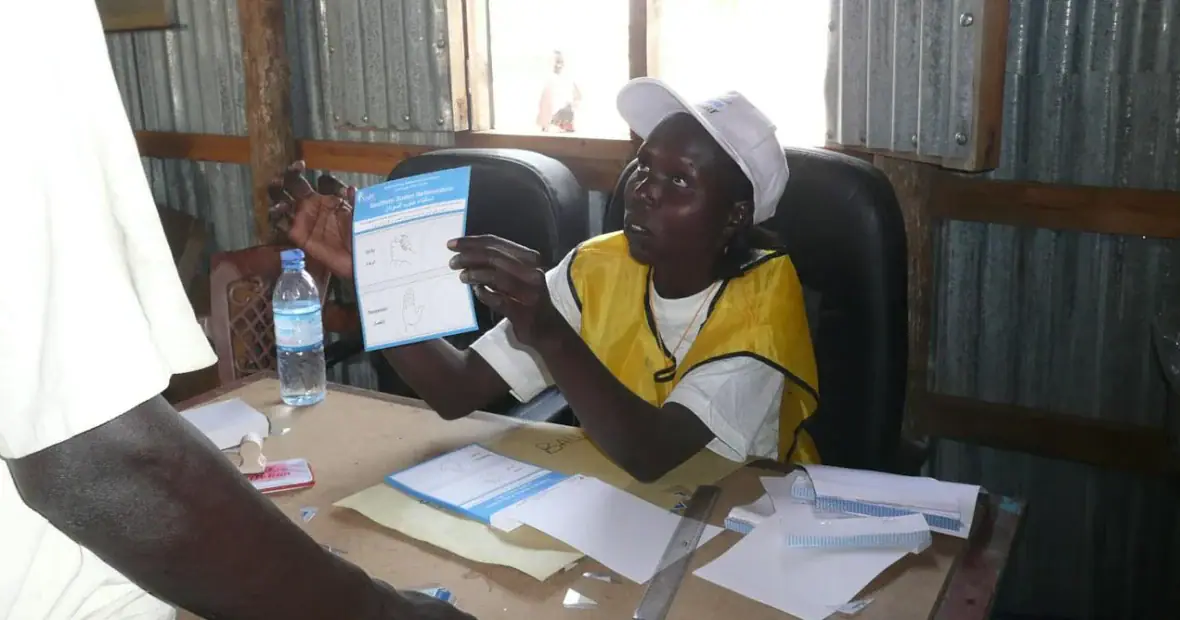
The National Elections Commission plans to register voters manually using paper registration books, which will then be entered into computer systems. This process faces several challenges, including training thousands of staff and reaching dispersed communities with poor roads and seasonal flooding. Many South Sudanese live far from their home areas, and around 2.5 million people are internally displaced, while over 2.3 million refugees reside in neighboring countries.
The electoral commission intends to accept confirmation of people's identities through community chiefs, enabling those without identification documents to participate in the process. However, this approach raises concerns about the accuracy and security of the voter registration process. Additionally, polling stations require personnel and equipment, and candidate nominations must be endorsed by registered voters.
The SPLM primaries have generated significant political activity, with hundreds of aspirants submitting applications for nominations. However, the process has also led to allegations of manipulation and disputes over candidate selection. The ruling party's dominance in many parts of the country means that winning its nomination may effectively determine eventual winners in several constituencies.
Given the significant challenges facing the electoral preparations, there are concerns about the feasibility of holding the elections on the scheduled date. Previous extensions of the election timeline have preserved the transitional power-sharing institutions established under the 2018 peace agreement. However, a further postponement would take place under different circumstances, with the caretaker government operating without parliamentary checks and balances.
Key points
- South Sudan's National Elections Commission faces significant challenges in preparing for the country's first general elections since independence, including a lack of an existing national electoral register and uncertainty over the amended electoral law.
- The electoral preparations are complicated by the internally displaced population and underdeveloped infrastructure.
- The ruling SPLM party's internal primaries have generated significant political activity, but also allegations of manipulation and disputes over candidate selection.