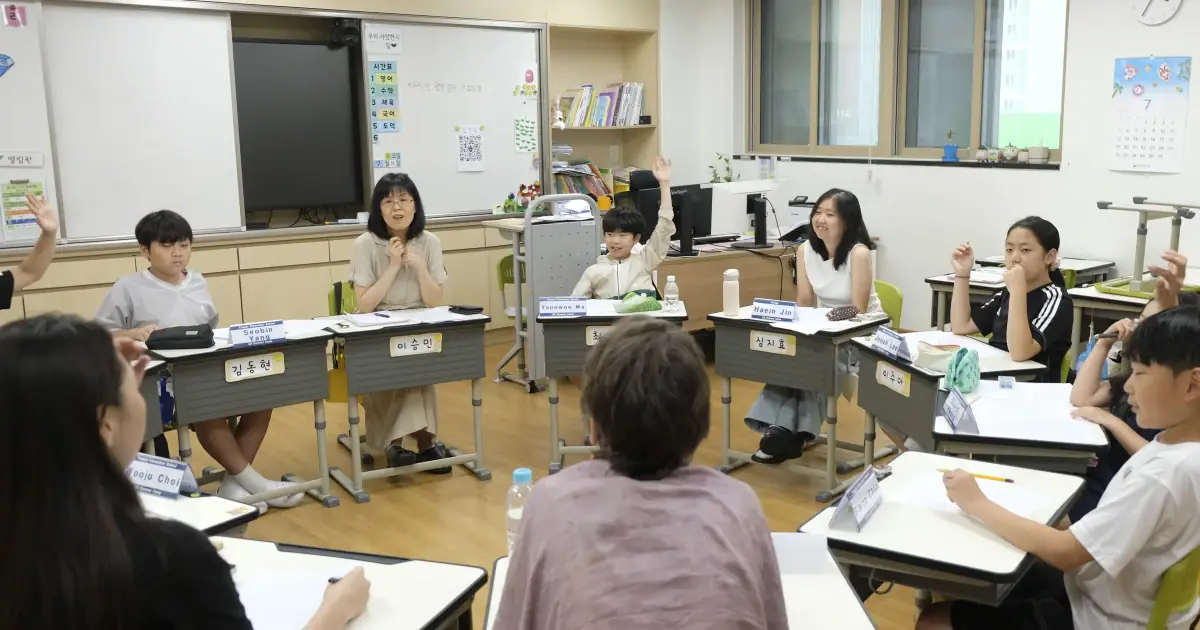
The city of Chuncheon, located 50 miles east of Seoul, has partnered with St. John's College in Annapolis, Maryland, to introduce the "Great Books" educational model in its schools. This approach, which focuses on discussion-based learning and critical thinking, has been adopted by Toegye public elementary school, where students engage in debates on classic literature such as Mary Shelley's Frankenstein. By guiding discussions rather than lecturing, teachers encourage students to develop their own ideas and reasoning.
The "Great Books" model, which has gained popularity in South Korea, aims to address concerning trends in the country's education system. International tests like PISA have shown a decline in reading skills among South Korean students, and the rapid adoption of AI in education has raised concerns. According to OECD figures, 51% of South Korean students use AI chatbots to study at least once a week. This has led to a renewed focus on critical thinking and independent reasoning.
The traditional South Korean education system, which emphasizes memorization and competition, has been criticized for leaving students with little time to read and think. Professor Lee Yonghwa of Incheon National University, who co-founded South Korea's first "Great Books" program in 2019, laments that Korean students are losing their capacity to memorize facts and think independently. The "Great Books" model seeks to address these issues by encouraging students to engage with classic literature and develop their own ideas.
Chuncheon Mayor Yook Dong-han, who introduced the "Great Books" model to the city, believes that this approach represents a "small but revolutionary achievement" that challenges established practices. The program has attracted significant interest among participating students, exceeding the mayor's expectations. With 120 college students and 770 younger students currently taking the "Great Books" program, and 40 teachers in training, the initiative is gaining momentum.
The "Great Books" model has been adapted to the South Korean context, with students reading works by Aristotle, Shakespeare, Euclid, and Korean authors like Nobel laureate Han Kang. In one Chuncheon high school, students discussed Martin Luther King Jr.'s 1963 Letter from Birmingham Jail, connecting King's ideas to their own country's experiences. This approach aims to foster civic participation and liberal education, promoting critical thinking and informed discussion.
The partnership between Chuncheon and St. John's College reflects a growing interest in alternative educational approaches in South Korea. As the country continues to grapple with the challenges of AI adoption and intense competition in education, initiatives like the "Great Books" model offer a promising solution. By emphasizing critical thinking, discussion, and independent reasoning, this approach seeks to prepare students for an increasingly complex and rapidly changing world.
The success of the "Great Books" model in Chuncheon may have implications for education policy in South Korea more broadly. As educators and policymakers seek to address the country's educational challenges, this approach may offer valuable insights and inspiration. With its focus on fostering critical thinking, civic participation, and liberal education, the "Great Books" model has the potential to make a lasting impact on South Korea's education system.
Key points
- The "Great Books" educational model, adopted by Chuncheon, South Korea, focuses on discussion-based learning and critical thinking to prepare students for an increasingly complex world.
- The model aims to address concerning trends in South Korea's education system, including a decline in reading skills and the rapid adoption of AI in education.
- The partnership between Chuncheon and St. John's College reflects a growing interest in alternative educational approaches in South Korea.