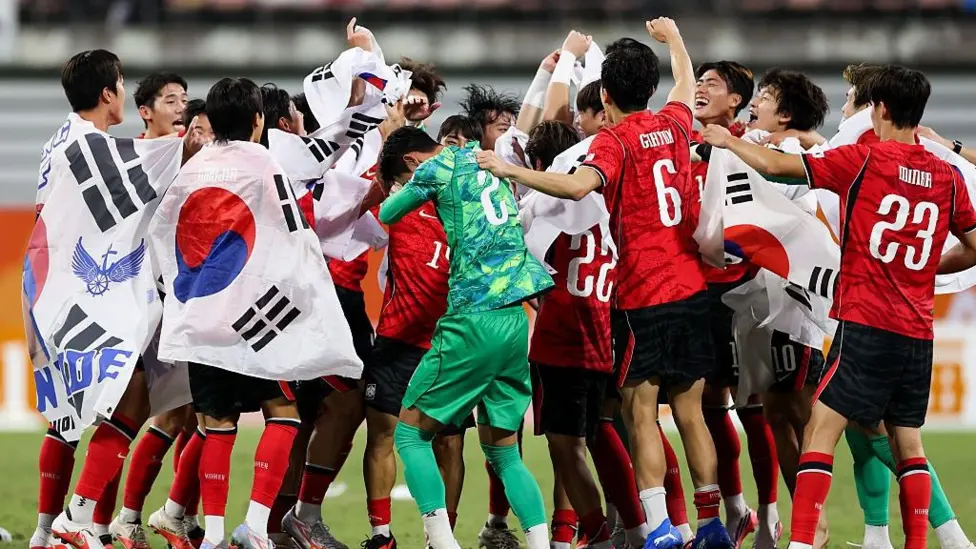
The South Korean government has announced plans to review the military service exemption system for athletes, following a controversy sparked by the country's football team after their Asian Games victory. The issue gained attention after three players, including captain Lee Gi-hyuk, were criticized for celebrating the military exemptions they secured through their gold medal win. Lee drew particular criticism after holding up his gold medal and saying he was "not going to the military," before later apologizing for his remarks.
The exemption system, which has been in place for over five decades, allows Asian Games gold medallists and Olympic medallists to exempt from active military service. However, recipients are still required to complete basic military training lasting less than a month. Culture, Sports and Tourism Minister Choi Hwi-young described Lee's comments as "utterly immature" and stated that the exemption system needed to be reconsidered. Choi noted that while the system has contributed to helping outstanding artists and athletes maintain and develop their abilities, the values attached to fairness and public perceptions of military service have changed.
The controversy has raised questions about the fairness and consistency of the exemption system across different sports. Democratic Party lawmaker Cho Kye-won pointed out that Olympic athletes who finish third or higher and Asian Games gold medallists qualify for the benefit, while athletes who win world championships in other competitions may not receive similar treatment. Cho also noted that most exemptions are concentrated in the Asian Games, with 36 out of 44 people who qualified for the benefit at the recent Asian Games being in soccer and baseball.
The exemption system has faced increasing scrutiny over whether its criteria remain fair and consistent. South Korean men are generally required to complete between 18 and 21 months of active military service before the age of 28. The government's review of the exemption system comes as South Korea continues to balance its mandatory military service requirements with policies aimed at supporting elite athletes and allowing them to pursue their sporting careers.
Minister Choi's comments indicate that the system could be reviewed as authorities consider concerns over fairness and changing public attitudes towards military service. The government has yet to announce specific changes to the exemption rules. However, the review is expected to address concerns over the concentration of exemptions in certain sports and the perceived unfairness among young people.
The debate over the exemption system has sparked a national conversation about the role of athletes in South Korean society and the balance between military service and sporting achievement. As the government reviews the exemption system, it will need to consider the competing demands of supporting elite athletes and maintaining fairness and consistency in the military service system.
The review of the exemption system is also expected to consider the impact on South Korea's sporting performance. The country's athletes have enjoyed significant success in recent years, including their Asian Games victory. However, the controversy over the exemption system has raised questions about the motivations of athletes and the values that underpin the system.
Key points
- The South Korean government plans to review its military exemptions policy for athletes amid controversy over celebrations by the country's football team.
- The exemption system allows Asian Games gold medallists and Olympic medallists to exempt from active military service.
- The review is expected to address concerns over fairness, consistency, and the concentration of exemptions in certain sports.