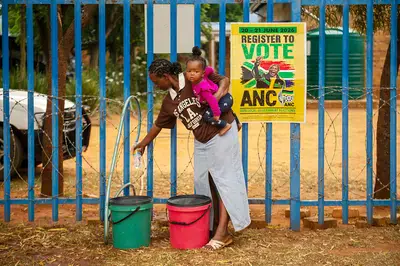
The upcoming local government elections in South Africa, set to take place on November 4, are expected to see a low turnout, particularly among the youth. According to the Electoral Commission, in the 2021 elections, voter turnout fell from 58% to 46%, with 90% of 18- and 19-year-olds not registering to vote. A 2025-26 survey found that 76% of young people believe political parties pay too little attention to their concerns.
The youth in South Africa are facing significant challenges, including a high unemployment rate of 61% among 15- to 24-year-olds. Many have expressed disillusionment with the current politics, feeling that their voices are not being heard. Mnqobi Mhlongo, a 21-year-old, stated that there is no difference between voting or not voting, as nothing will change. This sentiment is reflective of a generation that has lost trust in the system.
The Auditor-General has reported that nearly half of the country's drinking water systems failed microbiological safety standards, and almost every wastewater treatment works failed at least one effluent quality test. Infrastructure projects have been delayed by an average of 32 months. The crisis was foreseeable and avoidable, but it has still arrived. This is the ground on which the youth are being asked to vote.
The two main parties, the ANC and the DA, are struggling to connect with the youth. The ANC has been accused of corruption, while the DA has been criticized for its priorities, which exclude the majority. Neither party seems willing to own up to the stereotypes that people's lived experiences have confirmed. The ANC hears "corrupt" and reaches for its struggle credentials, while the DA hears "not for black people" and reaches for a screenshot of "a well-governed Mother City".
Young people in other countries, such as Serbia, Brazil, and France, have successfully organized and demanded change. In Serbia, a leaderless student movement grew into plenums, street assemblies, and a national refusal of corruption and negligence. Within two years, it had torn up 14 years of Aleksandar Vucic's dominance. Similarly, in Brazil and France, students have mounted large-scale resistance and demanded change.
The media's task in this election season is not to tell young people to vote but to show them what refusal and organization have looked like elsewhere and to ask the obvious question: What would it take here? The water crisis in Bronkhorstspruit, where hundreds of children have fallen ill due to contaminated water, is a stark reminder of the government's failure to deliver basic services.
As the local government elections approach, it remains to be seen whether the youth will continue to turn away from the polls. With the current politics failing to address their concerns, it is likely that the youth will continue to feel disillusioned. The question is, what will it take for them to organize and demand change, as their counterparts in other countries have done?
Key points
- The youth in South Africa are disillusioned with the current politics and are turning away from the local government elections.
- The ANC and DA are struggling to connect with the youth, who feel that their voices are not being heard.
- Young people in other countries have successfully organized and demanded change, providing a potential model for South African youth.