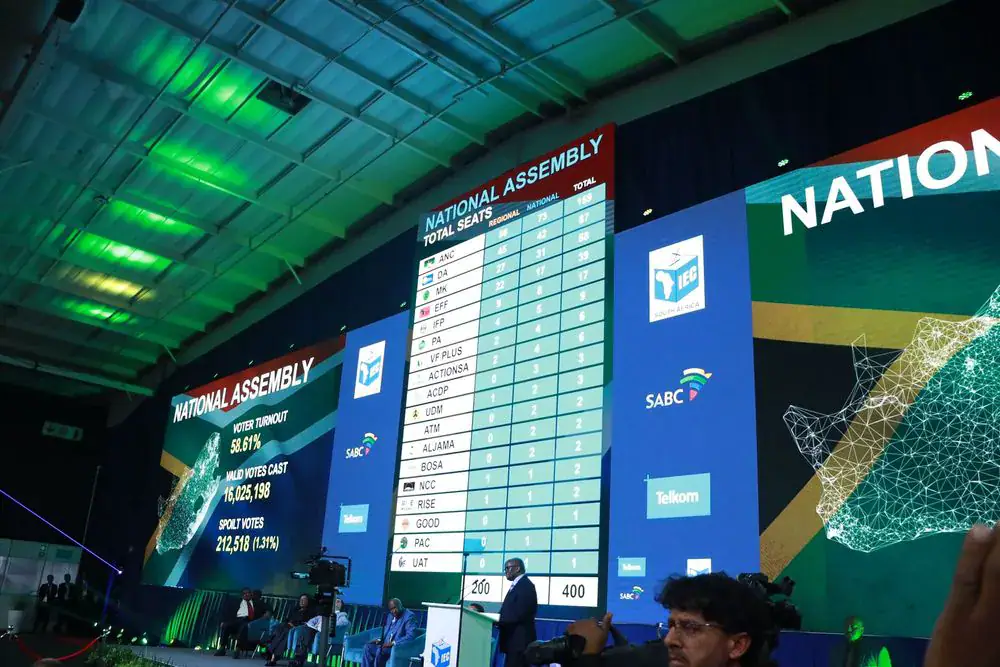
South African political parties are currently engaged in coalition negotiations in municipalities where no single party won a majority in the recent elections. These negotiations are taking place against the backdrop of a tight deadline, with parties having only 14 days to reach an agreement. The negotiations are crucial in determining the mayors and councillors in these municipalities. According to reports, parties are discussing their terms and conditions for potential coalitions.
The ActionSA party has made it clear that it is willing to work with the Democratic Alliance (DA) in the city of Johannesburg, but only if Helen Zille is not appointed as the mayor. Zille and ActionSA leader Mashaba have been exchanging words in the media, indicating a tense relationship between them. On the other hand, the DA has stated that it will not work with the MK Party, citing its alleged lack of organization and stability.
The MK Party has responded to the DA's comments, stating that it will only work with parties led by black people who understand the struggles of black South Africans. The Economic Freedom Fighters (EFF) has also made it clear that it will not work with the DA and the Freedom Front Plus. The EFF has had a successful meeting with ActionSA, according to reports.
Advocate Dali Mpofu, the national negotiator for the MK Party, has confirmed that his party has started coalition negotiations with other parties, but has not disclosed the progress of these talks. Mpofu has denied reports that the MK Party has conditions for working with the African National Congress (ANC), including the removal of ANC leader Cyril Ramaphosa.
The municipalities where coalition negotiations are taking place include Thekwini, Johannesburg, Ekurhuleni, and others. Political analyst Zakhele Ndlovu from the University of KwaZulu-Natal believes that smaller parties will play a crucial role in shaping the outcome of these coalition negotiations. Ndlovu cites the ActionSA, EFF, and South African Communist Party (SACP) as parties that could have a significant impact.
Ndlovu also notes that the terms and conditions announced by parties so far may not necessarily reflect their final positions. He believes that parties may change their stance once they are faced with the reality of forming a coalition. According to Ndlovu, parties are currently making public statements to gain mileage, but may be willing to compromise once negotiations are underway.
The coalition negotiations are taking place amidst a complex and dynamic political landscape in South Africa. The outcome of these negotiations will determine the leadership of municipalities where no party won a majority. The negotiations are also seen as a test of the parties' ability to work together and find common ground in the interests of their constituents.
Key points
- The negotiations are taking place in municipalities where no single party won a majority in the recent elections.
- The parties have only 14 days to reach a coalition agreement.
- Smaller parties are expected to play a crucial role in shaping the outcome of the coalition negotiations.