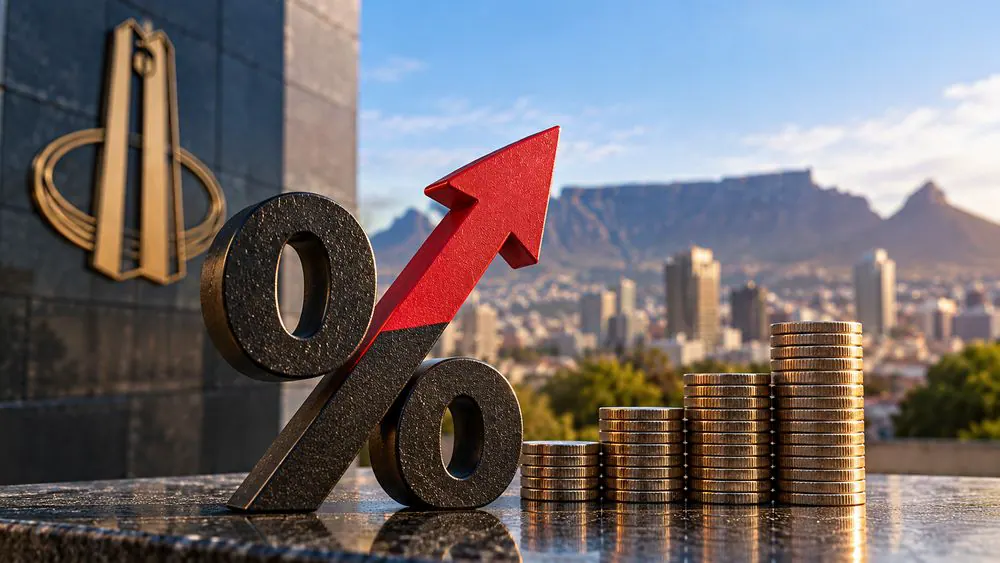
The South African Reserve Bank's (SARB) Monetary Policy Committee has unanimously increased the repo rate by 25 basis points to 7.25%, taking the prime lending rate to 10.75%. This move was widely expected, but some economists, such as PSG senior economist Johann Els, found the unanimous decision to be more hawkish than anticipated. Els notes that there were enough arguments for the MPC to leave rates unchanged, but the Bank's concern about the global supply shock persisting and pushing up inflation expectations ultimately won out.
Despite the unanimous vote, Els does not expect another increase under current conditions. The SARB's Quarterly Projection Model (QPM) also has no further increases in its base case, although Els cautions that the model should not be followed too literally as circumstances can change. Els believes that the fact that the SARB hiked in May and has now hiked again in September, while acknowledging that monetary policy is already restrictive, means that there should be no further rate increases under current circumstances.
Standard Bank Group head of South Africa Macroeconomic Research Dr Elna Moolman agrees that rates may now have reached their peak. She notes that it is very possible that this could be the peak in the interest rate hiking cycle, and it could be that the Reserve Bank has scope late next year to start providing some interest rate relief. However, Moolman emphasizes that this will depend on the path of oil prices and whether higher transport costs begin feeding through into other prices.
The possibility of further tightening comes as the domestic economy remains under pressure. Lara Hodes, economist at Investec, notes that consumer and business confidence remain subdued, while gross domestic product contracted in the second quarter. The SARB expects the economy to grow by 1.2% this year. Els notes that the Bank sees the risks to economic growth as being to the downside, with the global environment having a greater effect on South Africa than previously expected.
SARB is having to balance weak domestic growth against renewed external inflation risks. Rhys Dyer, CEO of ooba Group, notes that SARB is navigating an increasingly difficult balance between subdued domestic growth and renewed external inflationary pressures. Els believes that the weakness of the economy itself reduces the risk that inflation will become entrenched, as the economy is not strong enough to generate demand-driven inflation or a significant second-round price impact.
If conditions in the Middle East improve and oil prices fall sharply, the inflation outlook could improve more quickly than the SARB currently expects, opening the door to earlier cuts. Els notes that in that scenario, he thinks rate cuts could also be brought forward more than currently expected. He emphasizes that his expectation is no further rate increases after this one, under current circumstances.
Economists will be closely watching the trajectory of inflation, oil prices, the rand, and global interest rates in the months ahead to determine whether interest rates have indeed peaked. Further increases have not been ruled out, and Els notes that the SARB considered alternative scenarios in which global interest rates rise by more than assumed in its base case, resulting in another local rate hike and rates remaining higher for longer.
Key points
- Economists expect interest rates to remain at current levels before cuts become possible.
- The SARB's decision to hike interest rates was driven by concerns about the global supply shock persisting and pushing up inflation expectations.
- The domestic economy remains under pressure, with consumer and business confidence subdued and gross domestic product contracted in the second quarter.