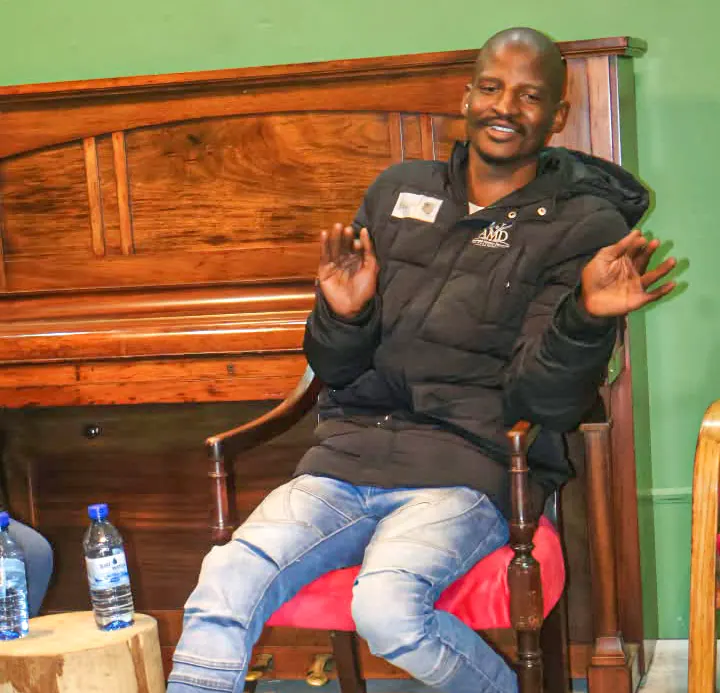
The second director's workshop at the October International Theatre Festival (OITF) in Eswatini proved to be a valuable experience for attendees. The workshop, led by South African director Moruti Dhlamini, focused on the relationship between director and actor, which is crucial for compelling storytelling. Moruti emphasized that projection is not just about volume, but about ownership, and that the audience should not have to find the actor's voice - it is the actor's responsibility to give them the voice.
Moruti stressed that an actor must fully inhabit their role and allow their body to respond instinctively to the text, rather than forcing emotion. He believes that listening is central to his philosophy, and that characters must truly listen to one another for authenticity to emerge. According to Moruti, every line delivered on stage should carry a dual purpose - the capacity to heal and to hurt. Without that emotional duality, dialogue falls flat.
The workshop turned interactive when one attendee raised a question about scripting and character interpretation. Moruti stated that understanding one's character is non-negotiable, and that actors must embody the character. He urged actors to interrogate what is written, seek clarity from the director, and never perform in confusion. One of the attendees introduced a compelling theory that resonated with the class - that an actor cannot play what they are not.
The attendee explained that if an actor is cast as a sangoma, for example, there is a sangoma within them, and their task is to locate that truth internally and honor it with respect and understanding. To do so, performers must be intimately aware of their own emotional tools and what the role demands of them. This approach allows actors to bring depth and authenticity to their performances.
Another participant asked how a director decides when to control movement. Moruti's response was refreshingly liberating - he emphasized that he gives actors the lines they are supposed to follow and gives them space to play, to look at their surroundings in their own way. He illustrated this with a vivid example, a gunman standing by the door, and explained that the actor need not have lived that moment, but must see the gunshot in their mind, visualize it, and let their body react truthfully.
Moruti further emphasized that a performer's responsibility is to be resourceful, to build an arsenal of references, lived observations, and emotional memories that can be drawn upon when the moment demands. He described this as having a million tools at one's disposal. The workshop provided valuable insights for aspiring creatives, and the attendees left with a deeper understanding of the delicate art of performance, presence, and character embodiment.
The October International Theatre Festival continues to provide a platform for artists to learn and grow. The festival has attracted a significant following on social media, with 525,000 likes on Facebook, 5,000 followers on Instagram, and 1.3,000 subscribers on YouTube. The event showcases the rich cultural heritage of Eswatini and provides opportunities for artists to showcase their talents.
Key points
- Moruti Dhlamini leads a workshop at the OITF, sharing insights on performance, presence, and character embodiment.
- The workshop focuses on the relationship between director and actor, and the importance of listening and authenticity in performances.
- Moruti emphasizes the need for actors to be resourceful and build an arsenal of references, lived observations, and emotional memories.