Energy poverty remains a significant challenge in South Africa, contributing to stunted childhood development and hindering inclusive economic growth. The country has abundant natural resources, making it feasible to deploy renewable energy technologies. Minister Kgosientsho Ramokgopa recently announced plans to increase Free Basic Electricity from 50 kWh to 200-300 kWh per household per month. However, the government's focus on market reform and cost-reflective pricing may not effectively address energy poverty.
The Integrated National Electrification Programme has been tasked with expanding the electricity distribution network but has been neglected over the past two decades. Despite increasing connections, the program's progress often falls behind the growing number of households. According to the Department of Electricity and Energy, 1.6 million households remain without electricity. Various policies and pilot projects aim to deliver energy services beyond the grid, but their impact has been marginal due to ambiguous mandates and fragmented responsibilities.
Research highlights the benefits of adequate energy services in poor households, where the value of each unit of energy is far higher than the system-wide aggregate. The Hungry for Electricity report by the Public Affairs Research Institute emphasizes the importance of subsidized electricity provision in addressing energy poverty. However, the Integrated Resource Planning process does not account for the socio-economic value of subsidized electricity provision, treating energy poverty as 'suppressed demand' that may be met in the future.
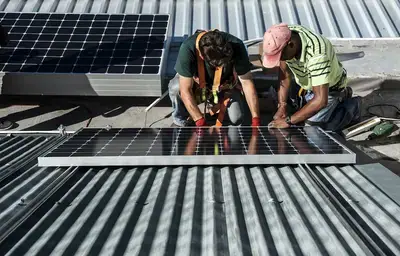
Social justice advocates argue that providing electricity to poor households is a key enabler of economic growth, even when measured by GDP. However, the prevailing capitalist economic model prioritizes projects that are 'bankable' and offer investors reasonable returns, marginalizing opportunities for decentralized and distributed renewable energy deployment. A coordinated large-scale roll-out of small-scale Solar PV with battery energy storage systems offers the quickest and most cost-effective means to achieve universal access to electricity by 2030.
Installing and maintaining distributed renewable energy systems is labor-intensive and offers significant job creation opportunities. Realizing the full potential benefits requires an ambitious national program over five years or more, backed by a major public finance commitment. The Department of Electricity and Energy proposed expanding the Integrated National Electrification Programme to fund off-grid renewable energy solutions, which was approved by Cabinet in August.
The Presidential Climate Commission Framework for a Just Energy Transition recognizes the principle of distributive, restorative, and procedural justice. The Commission has published research on distributed renewable energy, including opportunities for Socially Owned Renewable Energy. The JET Municipal Council, established to champion the implementation of the promised Universal Access Programme, could play a crucial role in promoting the deployment of solar PV and battery energy storage systems at scale.
A major commitment in the next national budget is essential for a program aiming to achieve universal access to electricity in the near future. Such public spending is justified by the distributed benefits, including generating employment, stimulating local economic activity, addressing gender inequality, air quality, and childhood development. The responsibility to seize this opportunity lies with Minister Ramokgopa and the Department of Electricity and Energy.
Key points
- A coordinated large-scale roll-out of small-scale Solar PV with battery energy storage systems offers the quickest and most cost-effective means to achieve universal access to electricity by 2030.
- Installing and maintaining distributed renewable energy systems is labor-intensive and offers significant job creation opportunities.
- A major public finance commitment is necessary to support an ambitious national program to achieve universal access to electricity.