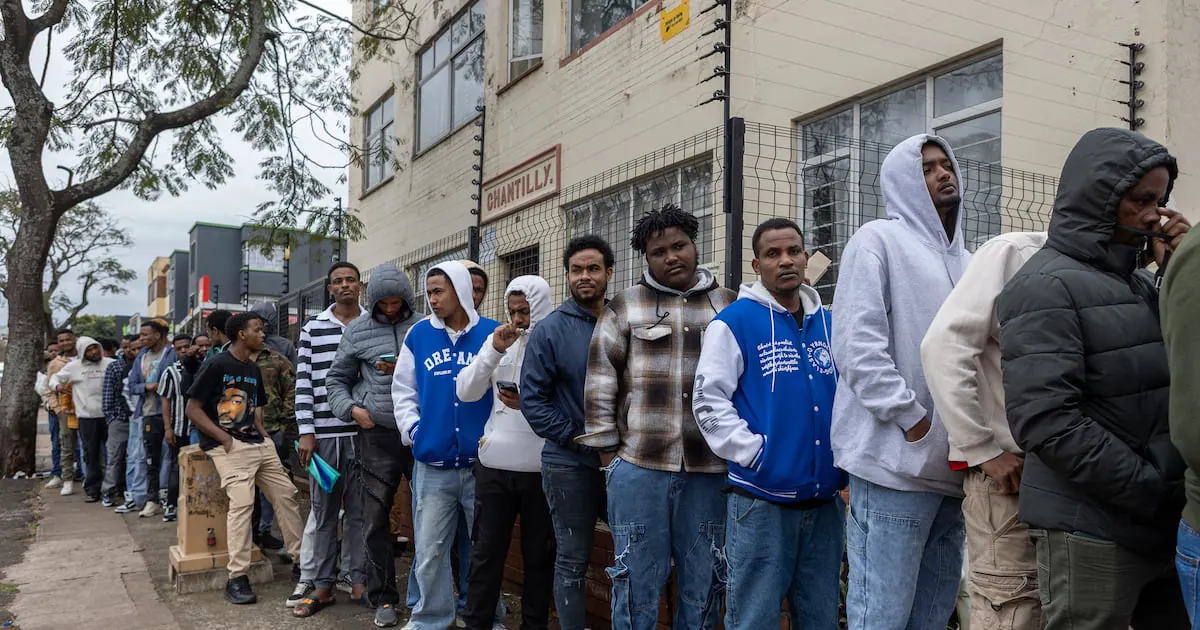
The South African government is seeking legal advice on managing asylum applications following a Constitutional Court ruling that has prompted a review of immigration procedures. Long queues have formed outside refugee reception centres due to misinformation about the ruling. Minister in the Presidency Khumbudzo Ntshavheni stated that the government is assessing its options to address the judgment's unintended consequences. The review aims to prevent confusion at refugee reception centres.
The Constitutional Court ruling requires officials to assess asylum claims without first excluding applicants who entered the country irregularly or failed to apply within prescribed deadlines. However, it does not automatically grant refugee status, citizenship, or voting rights. Despite this, misinformation circulating online has led to claims of a blanket amnesty for foreigners. The government has clarified that the ruling only requires the assessment of asylum claims to determine whether applicants qualify for refugee status.
The Department of Home Affairs will review its instructions to refugee reception centres to prevent confusion. Ntshavheni stated that the government will implement the ruling within its administrative capacity while considering its legal options. The department issued a directive in September after the court's July 7 judgment in a case brought by the Scalabrini Centre of Cape Town and its trustees. The court confirmed that provisions of the Refugees Act were unconstitutional.
The provisions that were deemed unconstitutional included requirements that applicants without valid visas first satisfy officials they had valid reasons for their circumstances before being allowed to seek asylum. These barriers prevented consideration of whether applicants needed protection and risked returning people to countries where they could face persecution or other serious harm. As a result, applicants must have their claims assessed to determine whether they qualify for refugee status.
The Department of Home Affairs has opposed the case but is constitutionally obliged to implement the judgment. The department has rejected allegations that the changes were initiated by the minister or political parties, or amounted to blanket legalisation of foreigners. Home Affairs has also referred what it describes as a co-ordinated disinformation campaign to the Electoral Commission of South Africa (IEC) under its code on countering disinformation.
The IEC has dismissed claims that asylum seekers can now vote, stating that only South African citizens aged 18 and older who are registered on the voters' roll are eligible. Applying for asylum does not confer citizenship, and asylum seeker status does not give a person the right to vote in South African elections. Ntshavheni warned that people who do not qualify for asylum or another lawful basis to stay would face removal after being processed.
The government has begun revoking asylum or refugee statuses obtained fraudulently after Special Investigating Unit investigations. The Department of Home Affairs is handling the revocations in batches and will release figures later. Justice minister and chairperson of the IMC Mmamoloko Kubayi supported extending the SIU investigation to cover the asylum system. The review of refugee policies aims to ensure that the system is fair and efficient.
Key points
- The Constitutional Court ruling requires officials to assess asylum claims without first excluding applicants who entered the country irregularly or failed to apply within prescribed deadlines.
- The government has clarified that the ruling does not automatically grant refugee status, citizenship, or voting rights.
- The Department of Home Affairs has referred a co-ordinated disinformation campaign to the Electoral Commission of South Africa (IEC) under its code on countering disinformation.